 Related Articles:

Inflation may be an undesirable consequence of our economic times. But when it comes to tires inflation is always a good thing, proper tire inflation, that is.
The amount of air required to properly inflate a tire depends on the size and type of tire, the vehicle application (size and weight), vehicle loading (normal or extra loading), and driving conditions. A tire that is properly inflated will provide safe driving, maximum traction, good handling and optimum tire life.
Increasing tire inflation pressure beyond the recommended amount will reduce rolling resistance, thereby improving fuel economy. But the trade-off is a harsher ride and increased risk of tire damage when encountering bumps.
Excessive tire pressure may distort the tread to the point where it bulges like a donut, reducing contact with the road and increasing wear in the center of the tread. Under no circumstances should a tire ever be inflated beyond the maximum rating as indicated on the sidewall.
By far, under-inflation is a more common and serious problem. Reducing inflation pressure increases a tire's rolling resistance and hurts fuel economy. Plus, an under-inflated tire flexes more, which leads to increased and uneven tread wear. As a rule of thumb, tire life decreases 10 percent for every 10 percent it is under-inflated.
Under-inflation also makes a tire run hot. Increased flexing of the sidewall increases the temperature of the tire, which in turn increases the risk of a tire failure and blowout.
A low tire can cause other problems as well. The amount of air in each tire affects weight distribution between the wheels. An under-inflated tire does not carry it is full share of the load. This, in turn, affects chassis loading, traction, steering, alignment and braking. It may also cause a noticeable steering pull when driving or braking.
An under-inflated tire can also break traction more easily than one which is properly inflated, which can cause skidding during braking or hard cornering, or wheel spin when accelerating.
If your vehicle has a Tire Pressure Monitoring System (TPMS), it should turn on your TPMS warning light if tire pressure in any tire drops 25% or more under the factory recommended inflation pressure.
Many motorists don't even know what the TPMS warning icon looks like (see the illustration below). A recent survey found that many motorists could not identify the TPMS warning icon. For details, seeTPMS Survey: 42 Percent of Motorists Cannot Recognize TPMS Warning Icon

How much air is the right amount to use? It depends on the application, the vehicle, the size of the tires and how much weight is on the tires. The simple answer is to follow the recommended inflation pressures specified by the vehicle manufacturer. The tire inflation specifications are generally listed in the owner's manual or on a decal in the glove box or door jamb.
For many passenger cars and light trucks, the recommended OE tire pressure may range from 28 up to 34 psi. Recommended pressures for front and rear may also vary, and higher pressures may be recommended for towing or hauling loads.
Keep in mind that recommended inflation pressure are for COLD tires. This means tires that have not been driven on for several hours (ideally overnight). It also means tires that are at a normal outside temperature of about 70 degrees F.
To accurately inflate a tire, you have to compensate for changes in temperature. For every 10 degrees F change in ambient temperature, tire pressure will change a little more than half a pound.
A tire that contains 32 psi of air at 70 degrees F will have a little over 35 psi at 100 degrees F - even if the vehicle has not been driven. Take a quick drive down the freeway and heat up the tires even more, and the pressure may read 38 to 40 psi.
Likewise, when seasons change and temperatures drop, tires lose pressure. They have not lost any air, but the air is not exerting as much pressure as before. The same tire that held 32 psi at 70 degrees F will have only about 28 psi when the thermometer hits 32 degrees F. And when temperatures are in the subzero range, the loss in air pressure will be several pounds more.
Altitude will also affect tire pressure. For every 1,000 feet in elevation above sea level, atmospheric pressure decreases about a half a pound. As a result, tire pressure goes up an equal amount. A tire gauge that reads accurately at sea level will read about 3 psi too high at an elevation of 6,000 feet.

Tire life decreases 10 percent for every 10 percent it is under-inflated. A tire that normally requires 32 psi of air and is would normally go about 80,000 miles will lose about 8,000 miles of expected tread life at 29 psi (assuming the vehicle is properly aligned).
The same tire under-inflated to 26 lbs. will lose about 16,000 miles of tread life. If under-inflated to 22 lbs., tire life will decrease by at least 24,000 miles.
Tires and alloy rims typically leak a little air over time, and with radials it is hard to visually check if a tire is low or not. That is why inflation pressure should be checked once a month. Yet few motorists do, and consequently, over 50 percent of all vehicles have one or more tires that are under- or overinflated.
Here's something else you should know: OLD tires leak more air than new tires. As rubber ages, it becomes more porous. An aging tire may lose up to several pounds of air a month. This is a clue that the tires are getting old and should be replaced. Old tires are dangerous and may fail without warning. The risk of failure is greatest at hight speeds during hot weather. Some tire manufacturers recommend replacing ANY tire that is 10 or more years old regardless of tread wear or condition.
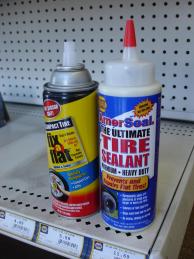
WARNINGIf you have a tire that is leaking air or a flat tire on a vehicle that has a direct Tire Pressure Monitoring System with TPMS sensors inside the wheels, do NOT attempt to fix the flat by using an aerosol tire inflator/sealer product unless the product is APPROVED for us with TPMS sensors. Some sealers may gum up the TPMS sensor inside the wheel and prevent it from reading normally. The aerosol inflator/sealer may or may not have a warning on the label stating it should NOT be used in wheels that contain TPMS sensors. All inflator/sealer products are safe to use, however, in tires on vehicles that have an indirect TPMS monitoring system (no sensors inside the wheels).
Tire inflation pressure should always be checked after a tire has mounted on a wheel to make sure it is within recommendations. If a bead is slow to seat, it can be very easy to over-inflate the tire (inflation pressure should never exceed 40 psi!). If the tire is overinflated, depress the valve stem core to vent some air. If it is low, add air.
Use an accurate tire pressure gauge. Gauges are often out of calibration (especially cheap ones). The trouble is you don't know if the gauge is accurate or not. Even if you own two tire pressure gauges and they both give you the exact same pressure reading, there is no guarantee they are accurate (though the odds are favorable that two gauges that read the same are probably accurately calibrated). The most accurate tire pressure gauges are the hand-held electronic digital gauges that are self-calibrating. The LEAST accurate are the dial type gauges found on most tire inflation machines at gas stations.
Air is about 78 percent nitrogen, and it is free. But air also contains oxygen (about 16 to 21 percent) and water vapor. Filling tires with 100 percent nitrogen has some important advantages over filling the tires with air.
One is that nitrogen molecules are larger than oxygen molecules, so tires leak less gas over time. Proponents of nitrogen inflation say tires filled with pure nitrogen maintain their pressure longer without having to add make-up air.
In October 2007, Consumer Reports released the results of a test they did on nitrogen filled tires. They inflated a number of used tires, some with air and some with nitrogen, then let the tires sit for a year. The air pressure in all of the tires when then measured to see which ones lost the most/least air. The Consumer Reports test showed the air-filled tires lost an average of 3.5 psi from their initial 30 psi inflation pressure, while the nitrogen-filled tires lost 2.2 psi of pressure (1.3 psi less). Though the difference was not dramatic, it did prove nitrogen-filled tires lose less pressure than air-filled tires. Critics said the Consumer Reports test would have shown more of a dramatic difference between air and nitrogen had the tires been subjected to real world driving conditions (which causes tires to lose pressure even faster).
In a Canadian large-scale truck fleet test, nitrogen-filled tires have shown measurable gains in both fuel economy (3.3%) and tire tread life (up to 86%!).
Another benefit is that pure nitrogen doesn't heat up as fast as air, so the tires run up to 20% cooler. This reduces tire wear and the risk of a sudden blowout when driving at high speed during hot weather.
Also, getting rid of oxygen eliminates oxidation that can attack tires from the inside out. Getting rid of the oxygen and water vapor inside the tire also eliminates the rust inside steel wheels, and corrosion inside aluminum wheels.
Of course, to maintain all of these benefits pure nitrogen must be used if the tires are low or need additional air. If you add ordinary air, you've just defeated all the benefits of filling the tires with nitrogen.
Tire dealers and service stations that offer nitrogen may charge $5 to $15 per tire for the inert gas. Is it worth it? That depends on whether or not you check your tires regularly (at least once a month). If you seldom check your tires, nitrogen would be worth the extra expense. And if you do a lot of high speed, hot weather driving, nitrogen can add an extra margin of driving safety.
For what it's worth, car enthusiast, celebrity and host of NBC's Tonight Show Jay Leno says he fills the tires on his collector cars and daily drivers with nitrogen.
NOTE: Tires that have been filled with nitrogen can be identified by GREEN caps that are installed on the valve stems. To maintain the benefits of nitrogen-filling, the tires obviously need to have nitrogen added if they are low and need air. If you add ordinary air, oxygen and moisture will contaminate the pure nitrogen inside the tire, reducing its effectiveness.
Related Articles: Click Here to See More Carley Automotive Technical Articles