
Home, Auto Repair Library, Auto Parts, Accessories, Tools, Manuals & Books, Car BLOG, Links, Index
Tire wear is a dead giveaway that the wheels are out of alignment or that steering or suspension parts are worn. So anytime you find unusual tire wear, be sure to give the steering and suspension a thorough inspection to find out what's causing the problem.
The following are different types of wear that can develop on your tires. It's important to visually inspect your tires periodically for wear because wear can affect safety, handling and braking. Some types of wear may also indicate worn or damaged steering or suspension parts that need to be repaired.
Toe refers to the parallelism of the wheels to each other. Toe misalignment typically produces a feathered wear pattern across both front tires, and/or inner shoulder wear on both tires (see the photo at the top of the page for an example of extreme toe wear). Front toe wear occurs when the front wheels bow out (too much toe out) as the vehicle is traveling forward. The underlying cause is often worn tie rod ends, but can also be caused by worn or loose inner tie rod sockets on rack and pinion steering gears, worn or deformed control arm bushings, a bent tie rod, bent steering arm or even misalignment in the rear wheels (which throws the steering off-center while driving straight). Measuring toe out with the wheels turned 20 degrees to either side can help you detect a bent steering arm.
If toe wear is accompanied by steering looseness or steering wander, there's a very good chance the tie rod ends are worn. Proceed to the steering checks. If toe wear is accompanied by steering pull or off-center steering, rear wheel toe alignment or axle alignment may be out of specifications.
Toe wear on the inside edges of the REAR tires on a vehicle with an independent rear suspension can also result from toe misalignment (too much toe out). The underlying cause may be rear rod alignment adjustments out of specifications, worn or damaged rear suspension control arm bushings, rear control arm bushings that have too much compliance (give) and allow too much lateral movement of the rear control arms, a bent rear control arm, or worn rear ball joints.
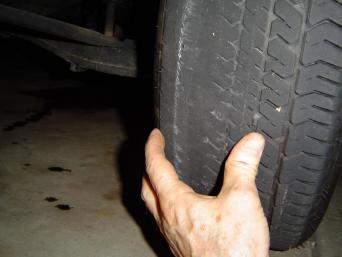
Uneven wear on one side of a tire tread may occur when the tire is leaning due to camber misalignment. The underlying cause may be bad control arm bushings, loose ball joints, a bent spindle or strut, or a strut tower that s out of its normal position (due to factory misassembly, collision damage, body sag or severe corrosion).
Another overlooked cause of camber wear can be a front-wheel drive engine cradle that has shifted out-of-position to one side. A weak or broken spring can also allow camber changes in the suspension that produce camber wear on a tire.
This may be the result of badly worn shocks or struts, or wheel and tire imbalance.
Uneven wear that occurs at an angle across the tread or along the edge of the tread on the REAR tires of a FWD car, minivan or SUV with an independent rear suspension. This type of tire wear can be caused by rear toe misalignment, worn rear control arm bushings, excessive flexing of the rear suspension or not rotating the tires often enough (every 6000 to 7500 miles is recommended). A slight variation is heel-and-toe wear that occurs along the inside edge of the tread. Heel-and-toe wear is caused by unwanted toe and camber changes that occur while driving. The uneven tread wear produced by diagonal wear or heel-and-toe wear makes the surface of the tire rough, which may produce a rumbling or humming noise while driving that sounds like a bad wheel bearing. You can usually feel the undulations and roughness on the tread by rubbing your hand around the circumference of the tire.

Tires have wear bars (flat spots)in the tread grooves to visually indicate wear. If the tread is worn down so the wear bars are flush with the surrounding tread, the tire is worn out and needs to be replaced. If you see cords showing through the rubber, the tire is unsafe to drive on and is on the verge of failure. Replace the tire without delay! The same advice goes for any tire that has bulges, deep cracks or the tread is separating from the casing.
 Tread wear can be measured using a penny. Place the penny with Lincoln's head upside down in a groove between the treads. If you can't see the top of Lincoln's lead, the tire is okay and still has some wear left in it. But if the top of Lincoln's head is flush with the tread, the tread depth is 2/32-inch (1.6mm) or less, indicating the tire is worn out and needs to be replaced.
Some experts now say the same test should now be done with a quarter. If the top of Washington's head is flush with the tread when you place a quarter upside down in a groove, the tread depth is 4/32-inch (3.2mm). Though the tire still has some tread wear left, braking, traction and handling are significantly reduced on wet pavement compared to a tire with more tread on it. Because of this, many experts now recommend replacing tires when the tread depth is worn down to 4/32-inch or less if you drive in an area that receives a lot of rain or snow.

 Toe or Camber Misalignment
The tires have to roll straight and true, be perpendicular to the road surface (camber) and be parallel to each other (toe) to minimize tread wear. If the wheels are out of alignment, tread wear will increase. Toe misalignment has the greatest effect on tread wear, while camber misalignment causes wear on the inside or outside edge of the tread.
If your tires are wearing unevenly or rapidly, you should have the alignment of all four wheels checked. If toe or camber are out of specifications, the wheels need to be realigned back to factory specifications. This should always be done if you are buying a new set of tires.
Worn Tie Rod EndsThe most common cause of rapid tread wear on the front tires is toe misalignment due to worn tie rod ends in the steering linkage. A bent tie rod or steering arm can also change toe alignment, but in most cases the problem is the tie rod ends are worn out and have too much play.
As a rule, inner and outer tie rod ends should show no visible vertical or horizontal play when rocking the steering back and forth with the full weight of the vehicle on its wheels. If you see any movement in the joint, the tie rod end needs to be replaced.
The inner tie rod sockets on rack and pinion steering gears are enclosed in bellows, making them more difficult to inspect. If the bellows are rubber, you can check for looseness by squeezing the bellows and pinching each socket while pushing outward on the wheel or while a helper rocks the steering wheel. If you feel movement, the sockets are loose and need to be replaced.
You can't do this check with hard plastic bellows, so lock the steering wheel with a holder and watch for any in or out movement in the tie rod while pulling and pushing on the wheels. Also pay attention to the rack mounts. Loose, deteriorated or broken mounts may allow the rack housing to move as the wheels are steered. This can cause steering wander and noise.
With parallelogram steering systems, pay close attention to the amount of play in the idler arm. Looseness here can cause steering wander and toe wear. Pitman arms should show no vertical looseness. Center links should be like tie rod ends and show no vertical or horizontal play.

The steering can be inspected using a technique called the "dry park" check. With the full weight of the vehicle on the wheels, have a helper rock the steering wheel while you look for play or looseness in the steering linkage and steering column. On some vehicles, this can be done by reaching up and rocking the steering column coupling from underneath while the vehicle is sitting on ramps or a drive-on ramp-style lift. The dry park method of checking for looseness is generally the best procedure to use because the weight of the vehicle on the wheels creates resistance that makes it easier to see play.
The dry park method is also a good way to find loose upper strut bearing assemblies. While rocking the steering back and forth, watch for strut movement in the strut tower opening. Any wobble would tell you the strut bearing plate is worn and needs to be replaced.
While rocking the wheel back and forth, also watch the control arm bushings for excessive movement. You can also check the bearings by gently prying against the control arm to see if the bushings allow much movement. A little "give" with rubber and elastomer bushings is normal, but if you see more than about 1/8 inch it may mean the bushing has collapsed. Metal bushings should have little or no play. Bouncing the suspension can help you identify noisy bushings.
Underinflated TiresIf the tires are not maintained at the recommended pressure and are underinflated, the tread flexes more than usual as the tire rotates. Over many miles, this will increase tread wear. Check the pressure in each tire with an accurate gauge, and inflate the tires to the pressure recommended in your owners manual or the inflation decal in the glovebox or door pillar.
Sagging Springs or Bent Suspension PartsWeak, sagging springs can cause a los of ride height that throws off wheel alignment. Coil and leaf springs sag with age, which can alter camber as well as caster alignment. Measuring ride height will tell you if the springs are still within specifications or not.
If ride height is below specifications, the springs need to be shimmed or replaced. If ride height is okay but camber is out of specifications and a tire shows heavy shoulder wear, a strut or steering knuckle may be bent. This type of damage can be found by having the Steering Axis Inclination (SAI) checked on an alignment machine.
A strut tower that is leaning in or out will affect camber alignment and show a SAI reading that is out of specifications. If the strut tower is pushed back or pulled forward, it will upset caster but SAI will still read within specifications.
A bent spindle can affect either camber or caster or both depending on which way its bent. Also, a bent control arm and/or collapsed control arm bushing can upset camber and/or caster.
Worn Ball JointsWorn ball joints can also effect wheel alignment and cause uneven tire wear. If the ball joints have built-in wear indicators, joint play should be checked with the weight of the vehicle on the wheels. Ball joints without built-in wear indicators are generally checked by raising the suspension to take the weight off of the joints. But procedures vary.
On rear-wheel drive applications with SLA suspensions where the spring is on the lower control arm, modified strut suspensions which also have the spring on the lower control arm, and front-wheel drive wishbone strut suspensions where the spring is on the strut but the strut is connected to the lower control arm, the lower ball joints carry the weight and must be unloaded to measure play. This is done by raising the vehicle and supporting the lower control arms to take the weight off the lower ball joints, then pulling on or prying against the wheel (not the ball joint) to measure vertical and horizontal play in both the lower and upper ball joints.
If an SLA suspension has the coil spring over the top arm, the upper joints are loaded. To check these joints, the vehicle has to be raised and the upper control arms blocked or supported to unload the upper joints.
With MacPherson struts, the strut supports the load so the lower ball joints are unloaded. To measure play, raise the vehicle and allow the suspension to hang free. Then push on or pry against the wheel to measure vertical and horizontal play in the lower ball joints with a dial indicator.
Worn Control Arm BushingsRubber or elastomer bushings are located in the ends of the control arms where they attach to the chassis. The bolt that passes through the bushings serves as a pivot point so the control arm can move up and down with the suspension. If the bushing has deteriorated or deformed with age, it can throw the control arm out of position causing a change in camber alignment. Worn bushings can be replaced to restore proper alignment, but the bushings require special tools or a press to replace. Replacing the stock bushings with firmer aftermarket urethane bushings can reduce compliance and flex for a firmer ride and better control.
 Worn Struts or Shock Absorbers
Tire wear can also be caused by worn struts or shock absorbers. The dampers help keep the tires in contact with the road as it encounters bumps and dips. Wear shocks or struts allow the wheels to bounce too much, which typically results in a cupped wear pattern on the tread. You may also feel the steering shudder after hitting a bump if the shocks are worn.
A "bounce test" will usually tell you if your shocks or struts are worn. Rock the suspension up and down several times, then release it. If the shocks are good, the vehicle should stop rocking almost immediately. But if it continues to rock up and down several times, you need new shocks or struts.
When visually inspecting the shocks and struts, look for:
Aggressive Driving Accelerates Tire WearTires don't last long on race cars, so they may need to be changed several times during a race. The same is true for tires on a vehicle that is driven aggressively, especially in city stop-and-go traffic. Hard cornering, spinning the tires when accelerating, and standing on the brakes can all wear tread off the tires very quickly. Teenage drivers and people who drive pizza delivery vehicles can wear out tires extremely fast. Changing your driving habits can extend tire life and save you the cost of having to replace your tires prematurely.
Cheap Tires Don't Wear WellThe ingredients that go into the rubber compound to make the tread have a huge bearing on how well a tire can resist wear. The higher the amount of carbon black, silica and other wear-resistant ingredients in the compound, the tougher the tread and the longer it will last. But the trade off may be increased ride harshness and loss of dry traction. Tire manufacturers choose formulate compounds to optimize traction, tread wear and cost. Cheaper tires as well as racing tires typically use softer rubber compounds. Softer rubber is good for dry traction, but not for wear resistance.
Tires with low tread wear ratings (300 or less) will not last as many miles as tires with higher tread wear ratings (over 500). The higher the tread wear rating, the more miles you should get from your tires. The tread wear rating can be found on the tire sidewall.
How many miles should you expect to get from a new set of tires? How long a given set of tires will actually last on your vehicle depends on a number of variables. These include the tread wear rating of the tires, wheel alignment, tire inflation pressure, whether or not you rotate your tires regularly, how you drive your vehicle (aggressive driving and braking increases war dramatically), the type of road surfaces on which you drive (rougher roads increase wear) and ambient temperatures (hotter weather is harder on tires).
The TREAD WEAR rating on the sidewall of a tire gives a relative index rating of tread life compared to other tires. Tire manufacturers are careful NOT to make a specific mileage claim based on the tread wear number because of the variables that can affect tire life we just listed. However, you can use the tread wear rating index to get a rough approximation of how long your tires SHOULD last provided the wheels on your vehicles are within alignment specifications, you keep your tires properly inflated, and you rotate all four of your tires every 6,000 to 7,500 miles.
The higher the tread wear index rating, the more miles the tires should last. In general tires with ratings of less than 300 are soft compound tires that have been optimized for dry weather traction. Some racing tires may have tread wear ratings as low as 120 to 140. Many premium quality passenger car tires will have a tread wear rating in the 400 to 500 range. Some tires may have a tread wear rating over 600 and are made with special rubber compounds optimized for maximum tire life.
Here's the rule of thumb for estimating tire life using the three-digit tread wear index number on the tire:
Double the tread wear index number, then multiply 100
Example: A tire has a tread wear rating of 400. If you double the index rating and multiply by 100 you get a projected tire life of 80,000 miles. This is the number of miles a tire with a tread rating of 400 should be capable of achieving under normal circumstances with non-aggressive driving, proper maintenance and wheel alignment. This is no guarantee the tire will actually last that many miles, but it should come fairly close provided you check and maintain the tire inflation pressure to the recommended pressure, rotate the tires as required, and have no alignment or chassis problems that would cause rapid or uneven tire wear.
Most tires come with about 10/32 inch of tread depth when new. Tires should be replaced when the tread is worn down to 2/32 inch, which means the tire wears about 8/32 inch during its lifespan. If a tire lasts 80,000 miles, it wears about 1/32 inch for every 10,000 miles driven. If a tire lasts 60,000 miles, it wears 1/32 inch for every 7,500 miles driven. If a tire lasts 40,000 miles, it wears 1/32 inch for every 5,000 miles driven. These are approximations because the rate at which any tire wears will depend on the hardness or softness and flexibility of the rubber compound in the tire, wheel alignment, how the tires are maintained and how the vehicle is driven.
Tire retailers and manufacturers often offer a pro-rated mileage warranty on certain tires. The warranty does NOT guarantee the tire will actually last the advertised number of miles, but it does imply the mileage potential of the tire for normal driving. The pro-rated warranty means if the tread on the tire wears down to 2/32-inch before the warranty mileage is reached, the tire dealer or manufacturer will note how many miles the tires actually lasted, subtract that number from the warranty mileage on the tire, and give you a certain amount of credit toward your next set of tires you purchase from them.
Example: Say you buy a new set of tires that are warrantied to last 75,000 miles. But the tires wear out in 50,000 miles (and there are no alignment issues, no worn or damaged steering or suspension parts that would void the tire warranty, and you had the tire dealer rotate your tires every 6,000 miles). Because you only got about two-thirds of the expected tire life, the tire dealer owes you the equivalent of 25,000 miles of tread wear you didn't get. He should take about one third off the price of the next set of tires you buy to offset the difference. That's how a pro-rated tire warranty usually works.
If you need to buy tires, buying a set of used tires may seem like a more affordable alternative. Used tires are a risk, but they can be safe if they meet certain criteria (not too old, not badly worn, and no tire patches or plugs in the shoulders or sidewalls). For more information on this subject, see Used Tires.
WARNING: DO NOT USE OIL, GREASE, ANTI-SEIZE OR LUBRICANTS ON LUG NUTS
WHEN CHANGING OR ROTATING TIRES
Proper torque on lug nuts is very important for three reasons. One is to keep the lug nuts from loosening up and the wheel coming loose, another is to prevent distortion of the brake rotor behind the wheel, and a third is to prevent broken studs. A torque wrench should ALWAYS be used for final tightening of the lug nuts, and the nuts should always be tightened to the recommended specifications.
CAUTION: Torque specifications for lug nuts are for CLEANand DRY studs and lug nuts. That means no oil, no grease, no anti-seize and no lubricants of any kind. Any of these products will reduce the friction between the threads. This may seem like a good thing to prevent rust and frozen lug nuts, but the reduction in friction means a much higher percentage of the applied torque (up to 25% or more) will go toward loading the lug nuts. The end result may be brake rotor distortion or broken studs!
Wheel studs should be cleaned with a wire brush to remove rust and dirt BEFORE the wheels are mounted. If the lug nuts are heavily rusted or have damaged threads and will not turn easily on the studs, replace the lug nuts. The same goes for any wheel studs with damaged or badly corroded threads.
 More Tire Articles:
 Click Here to See More Carley Automotive Technical Articles