Home, Auto Repair Library, Auto Parts, Accessories, Tools, Manuals & Books, Car BLOG, Links, Index

The newest hi-tech buzzword in automotive electronics today is "Telematics." According to Motorola, the company who coined the term, it is "an emerging automotive communications technology that combines wireless voice and data to provide location-specific security, information, productivity and in-vehicle entertainment services to drivers and their passengers."
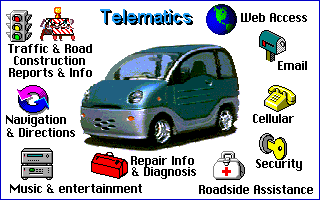
In other words, what telematics is attempting to do is to bring together a number of different technologies and combine them into one easy-to-use platform that is customizable to each individual driver. The basic idea is to have some type of in-dash unit that combines the functions of a web radio, email, ecommerce, cell phone, global positioning satellite navigation system and driver assistance program into one.
As it stands now, telematics could provide all of the following:
* Safety & Security. This includes such services as roadside assistance, emergency service, automatic accident reporting (when the air bags deploy), vehicle recovery (in case your vehicle is stolen), remote release of door locks (should you lock yourself out of your car), or a live contact should you need anything while driving.
* Navigation & Traffic Information. Using server based real-time assistance, telematics can help drivers find locations, avoid traffic congestion, accidents, construction, etc. Unlike older CD navigation systems that need to be periodically updated and may only cover a limited area, downloading navigation info as directions or help is needed means the information can be current.

* Entertainment & Personal Information. Telematics can bring you the news, weather, sports, stock quotes, email (more likely voice mail to help you keep your eyes on the road), remind you of scheduled appointments or other events you have on your personal calendar, maybe even help you shuffle your schedule as you drive to work.
* Remote Service Functions. Included here would be diagnosing and reporting vehicle drivability and emission problems back to the car dealer or other service facility, monitoring the need for scheduled maintenance (oil changes, filters, etc.), and possibly even providing "live" reprogramming of engine computer functions if updates are needed.

* Vehicle-to-vehicle (V2V) communications. The federal government wants cars to talk to each other to reduce accidents. Communication between vehicles allows vehicles to "see" other. This situational awareness means the automatic braking system may be activated if the driver fails to see an approaching vehicle at an intersection. It also means that smart cruise control systems can space vehicles closer together when traveling on highways to reduce congestion. The cruise control system can also sense a problem ahead if a lead vehicle starts to brake, giving it time to slow the vehicle and avoid a rear-end collision. The National Highway Traffic Safety Administration (NHTSA) is considering a rule that would require V2V on future vehicles.
Virtually every vehicle today has a radio and CD player, and many luxury vehicles are equipped with video screens, navigation systems, hands-free, built-in cell phones and driver assistance "HELP" buttons like General Motor's OnStar, Ford's RESCU, Mercedes' Tele Aid, etc. But currently, most of these are separate functions controlled by separate devices. As time goes on, more and more communications and infotainment within the vehicle will be integrated into single systems. Some luxury vehicles already offer such with touch screen displays that control numerous functions. On newer vehicles, these systems will even sync with your smart phone so you can play music, read email and text messages, make calls and surf the internet.
Radio is evolving, too. The way it is now, you can choose any AM, FM or satellite station you want to listen to, but you can't tell the DJ what to play or to cut the chatter. You're a passive listener, and there's no way to mute out those annoying commercials that saturate the AM and FM airwaves during peak drive times. Even satellite radio is becoming more commercial. The next step in telematics may be the airwave equivalent of Netflix, some type of "eradio" that plays what you want on demand (for a fee, of course). More likely, there will be a shift to streaming radio over an internet connection in your vehicle.
For more info on what's happening in the world of Telematics Click Here for information about Telematics and the Connected Car.
Today's real time navigation systems can provide current traffic and road construction information (as well as alternate route suggestions to avoid you avoid traffic jams. With V2V communications, onboard navigation systems get smarter and can detect traffic congestion ahead or on side roads, giving you warnign of impending traffic jams or less congested alternate routes.

Another possible use for telematics is to open up communication between a vehicle as it is traveling along and nearby businesses. For example, let's say you're driving down the road and your stomach tells you it's time for a Big Mac. You tell your onboard telematics unit that you want the nearest McDonalds. You instantly get directions to the nearest McDonalds -- and may even be able to preview the menu or preorder your Big Mac so is it is waiting and ready when you pull up to the drive-thru lane.
Or say you're driving down the street and a local fast food restaurant wants to entice you with a special offer. When you're in range, they might flash your telematics unit with a message inviting you to stop by for a special $3.99 meal. When you pull into the establishment, their transponder recognizes your vehicle, has your meal waiting and gives you the special discount for responding to their offer.
People want a pleasant driving experience when they are behind the wheel, so some vehicle makers are offering systems that can be customized to individual preferences. Like customizing your smart phone icons, you can modify or change the layout or appearance of the controls on your instrument panel or touch screen.
What if the same vehicle is used by different drivers (such as you, your spouse and any teenage drivers that might be in your family)? Then you have a special onboard profile for each driver just as many vehicles now have memory settings for power seats and mirrors and pedal positions. When you enter your vehicle, your smart key fob communicates with your car and tells it how you want it set up. It might even turn on your favorite radio station and have the car pre-warmed or pre-cooled with the remote start system.

"Blue Tooth" is a standard for using wireless radio waves to send data short distances from one device to another (say from your cell phone to the onboard telematics system in your vehicle). It's essentially the same technology that is used in many states for electronically collecting road tolls from motorists.
A bluetooth onboard transponder can also be used to monitor real time traffic conditions with roadside sensors. The vehicle becomes a mobile for the traffic management systems. This could allow traffic lights to change when a vehicle approaches an intersection to save time and fuel.
Privacy advocates don't like the idea of being monitored while their are driving. But guess what? You're already being monitored if your vehicle has a GPS navigation system, OnStar or an electronic toll road transponder. The police in many large cities also have automatic license plate scanners that can read vehicle license plates as they pass by to check for outstanding tickets or warrants or stolen vehicles. So like it or not, Big Brother is keeping an eye on you while you are driving, and it is only going to become more invasive.
Some insurance companies have a monitoring device that you plug into your OBD II connector under the dash. The devise tracks vehicle speed and braking and reports the results back to the insurance company to monitor your driving behaviors. Good drivers (those who don't speed, do jack rabbit starts or slam on their brakes) are rewarded with insurance discounts while not so good drivers pay higher rates.
With more fuel efficient hybrid and electric vehicles on the road, governments are worried they may experience a drop in gasoline tax revenue. Several states are considering taxing drivers based on miles driven, how fast they drive, or even where they drive to boost revenues. This would likely require some kind of telematic monitoring and reporting system that would be installed in your vehicle much like a toll road transponder.
One benefit of vehicle monitoring and tracking is that it can make life more difficult for car thieves. OnStar can remotely slow or disable a vehicle if it has been reported stolen. It can also locate the vehicle using the built-in GPS system.
Auto finance companies would love the ability to track the whereabouts of a vehicle so they could repossess it if the motorist failed to make their payments on time.
Most over-the-road heavy-duty trucks have GPS transponders that track their speed and movements. This information helps dispatchers track shipments as well as driver behavior (or misbehavior).
Conceivably, we could even be issued tickets electronically for speeding, failing to obey traffic signals, emitting too much pollution or even illegal parking via telematics. The companies that install red light camera and speed camera wouldn't like this, but municipal governments would love the boom in revenue. That's the Dark Side of telematics.
You might think that you own any telematic data your vehicle generates because you own the car and you are the one driving it. Or, you might think the data belongs to the car dealer to help them with service and repair. Actually, under current law (September 2016), telematics data belongs to the vehicle manufacturer - and the authorities in cases where accident investigation requires accessing airbag deployment data (such has how fast you were traveling when the air bag deployed and whether or not the brakes were being applied at the time of the crash). This kind of information can be critical in deciding who's at fault in an accident, and if a traffic violation occurred.
The Auto Care Association is currently pushing for legislation that would change who owns telematic data and who can access the information. Consumers should control their own data, and independent repair shops should also be able to access it when vehicle service or repairs are needed.
Something else telematics can do is talk to the onboard powertrain computer. If a problem occurs and a trouble code is generated, the telematics can report the problem back to the new car dealer -- and maybe even schedule a service appointment. OnStar does that now, and notified the motorist if their vehicle has a problem. OnStar can even offer remote diagnostics and alert the driver if a problem is potentially serious.
When a Check Engine light comes on there's no way to know in most vehicles if the problem is serious or not. Is the engine running dangerously hot or did the EVAP emission control system fail a check? In one instance, ignoring the light could be very damaging while in the other it's no big deal and can be fixed later. With telematics, additional diagnostic information can be provided to the driver to help them evaluate the problem and come to a decision (keep driving, pull over to the side of the road or seek out a service facility).
If the telematics unit is interlinked with the onboard engine computer, it's also possible that certain kinds of drivability and emission problems might even be fixed by downloading new settings or calibrations to the vehicle computer. This would save a trip back to the dealer and would allow vehicles to be "upgraded" as the need arises on the go and even without the owner's knowledge (automatic upgrading).
Motorola, Visteon and other companies are developing systems that would allow car dealers to query your vehicle electronically via some type of wireless link to get service and repair data. Let's say the oxygen sensor on your vehicle dies. The onboard diagnostics detects the loss of signal, alerts the driver that the oxygen sensor has failed and reports the trouble code back to the dealer. If the telematics system is then used to schedule a service appointment, the dealer would already have the diagnosis in their computer, and have the part ordered, delivered and ready to install when you arrived hopefully saving time and inconvenience. At the same time, the dealer could pull up your maintenance and repair history, query your vehicle to see how miles it has been since your last oil change, etc., and be prepared to sell you a whole laundry list of services you may or may not want.
The downside to all this high tech service marketing is that the independent garages and service facilities would be hard pressed to compete with the new car dealers electronic lock on their customer base. Such technology obviously isn't cheap, and takes a lot of setup and management to function as intended. Who would control access to the vehicle service data and the vehicle fixes? Would the aftermarket be shut out of this high tech endeavor or would only the largest retailers and chains have the financial resources and means to partner in the technology?
Car-Net's latest upgrades include a new mobile appthat offers more features and faster response time. Car-Net will be standard on most 2020 models with Remote Access services at no charge for five years. The upgrade also offers 4G LTE WiFi capability standard with a data plan subscription.
Car-Net Remote Access gives owners the ability to interact with their vehicle from miles away via the mobile app. It is offered at no additional charge for five years from the date of vehicle purchase. Features include remote start and stop, remote door lock and unlock, remote honk and flash of lights, last parked location, and remote vehicle status display, which provides information on fuel level, mileage, and door and window status.
Volkswagen owners with factory-installed navigation can send destinations or points of interest directly to their car from the app, helping to save time. Vehicle owners will also be able to connect their VW Car-Net account to compatible smart home devices to send voice commands to their vehicle to check the fuel level or remote start the engine.
Powered by Parkopedia, the Parking Information feature can help make owners’ lives easier by locating off-street parking information. Through the Navigate tab on the app, users can click the “P” icon to show available parking locations, either in the immediate vicinity or near a Point of Interest. Clicking on a specific location will display the address, hours of operation and pricing. Users can also send the location to their car’s navigation system, if so equipped, by clicking the “Send to My VW” button.
Vehicle Health Reports can provide owners easy access to diagnostic information. Reports generate automatically each month after enrollment, and are sent directly to the email address in the owner’s profile; owners can also request updated reports anytime through the mobile app. When it is time for scheduled service, Car-Net can not only notify the customer, but also provides a simple way to schedule a dealer visit.
Family Guardian services and Roadside Call Assist can provide added peace-of-mind no matter who is driving. Speed alert notifies the owner when the pre-determined maximum speed limit is exceeded. Boundary alert lets the owner know when the vehicle has traveled outside of a pre-set virtual boundary. Curfew alert notifies the owner if the vehicle is driven while curfew alert is on. Valet alert alerts if the vehicle is driven more than 0.2 miles from the valet drop-off location. The Car-Net app allows users to control who receives notifications by designating primary and secondary users, with varying levels of control and functionality for each. Notifications can come in the form of text messages, emails, or push notifications from the mobile app itself. If the vehicle is disabled, Roadside Call Assist available at the touch of the wrench button.
The DriveView™ program is new for 2020. By enrolling in this program, Car-Net users may be eligible for discounted rates from some of the top automotive insurance companies in the country. This program can also help Car-Net users monitor their driving by tracking activities like night driving, hard braking, idle time, and excess speed. These factors all contribute to an overall driving score, which is visible within the mobile app.
Car-Net Safe & Secure is a paid subscription service that includes Information Assistance, Emergency Assistance, Automatic Crash Notification, Anti-Theft Alert, and Stolen Vehicle Location Assistance. The subscription is $99 per year before taxes and fees, and automatically renews annually at the end of the subscription term, unless cancelled.
Information Assistance—accessed through the i-call button within the vehicle—allows the driver to speak to a Car-Net agent for support needs, such as points of interest and account services. Emergency Assistance can be accessed through the SOS button in the vehicle, and, if a cellular connection can be established, puts the driver in contact with the Car-Net service center, who can direct emergency responders to the vehicle’s location and notify the user’s Emergency Contact. Provided a cellular connection can be established, Automatic Crash Notification can help automatically notify an operator who can quickly contact first responders in the event of a collision. Anti-Theft Alert sends a push notification to the user if the vehicle’s anti-theft alarm is triggered, and Stolen Vehicle Location Assistance uses Car-Net to assist law enforcement with locating the vehicle in the event that it is stolen.
Car-Net Hotspot allows passengers to access the internet with up to four connected devices simultaneously, including tablets, smartphones, laptops, gaming devices, and more—all at 4G LTE-enabled speed. Existing Verizon Wireless customers with an unlimited mobile data plan can simply add their Volkswagen vehicle as a new line item to their existing plan; non-Verizon customers can set up a prepaid plan for $20/month before taxes and fees.
Car-Net Guide & Inform offers an enhanced navigation and infotainment experience for VW owners with a factory-installed navigation system. Drivers can access traffic reports, fuel prices, sports scores, movie times, and weather data as part of the three-month SiriusXM Travel Link trial. Car-Net enrollment and subscription is not required.
 More Automotive Technology Articles: