

An engine that uses oil is a problem nobody wants. Most engines in new vehicles today should not use any oil within a span of 3,000 miles, and no more than one quart between extended oil change intervals of 5,000 to 7,500 miles. The same holds true for older engines that may have up to 75,000 miles on the odometer, are i n good condition and have been properly maintained (regular oil and filter changes).
However, oil consumption will slowly increase over time as an engine accumulates miles and wear. The rate at which oil consumption goes up should be very slow and gradual. A sudden increase in oil consumption would signal a potential problem that should be investigated.
If your engine is using a quart or more of oil every 1,000 to 1,500 miles, you have a problem regardless of the age or mileage on your vehicle.
As for older, higher mileage vehicles (those with more than 75,000 miles on the odometer), using a quart of oil every 1,500 to 3,000 miles is not unusual. However, if your engine is using more than a quart of oil every 1,000 miles, it means your engine has a serious oil leak or some severe wear problems that may require expensive repairs.
If you do a Google search on High Oil Consumption Problems, you will see a lot of consumer complaints about certain late model engines that use too much oil. The auto makers often deny these engines have a problem and try to shift the blame back on the consumer for not checking or maintaining their oil properly. But manufacturing mistakes do occur, and certain engines may use too much oil because the cylinders were not finished properly at the factory, because the piston rings are not sealing properly because of a manufacturing defect, because the valve guide seals are not doing their job (poor design, improper materials or assembly), or because the Positive Crankcase Ventilation (PCV) system is sucking too much air and oil vapor back into the engine (design flaw).
Some car makers claim using up to a quart of oil between changes is "normal" for high revving performance engines. Others may say using a quart of oil every 2,000 to 3,000 miles is normal for specific engines. We do not agree!.
A newer late model low mileage engine that is using more than a quart of oil between changes definitely has a problem. It might just be a leaky gasket or seal, or it could indicate a manufacturing defect such as defective or improperly installed piston rings, improper cylinder bore finish, or a poorly designed Positive Crankcase Ventilation (PCV) system that sucks too much oil vapor from the crankcase back into the intake manifold.
Some defects can cause excessive oil consumption may be covered under the OEM powertrain warranty. Others may be covered by a factory Technical Service Bulletin (TSB) and/or special extended warranty. Check with your new car dealer to see if any of these may apply to your vehicle.
A common engine assembly mistake is installing the piston rings upside down. Compression rings have a dot or mark that indicates which side faces up (towards the top of the piston). This is especially critical with the 2nd oil ring because it often has a tapered face that scrapes oil off the cylinder wall as the piston moves down. This pushes the oil back towards the crankcase and away from the combustion chamber. If the 2nd compression ring is installed upside down, it will scrape oil up and push it toward the combustion chamber causing a big increase in oil consumption.
How can you tell if your engine is using oil? Check the dipstick every month.
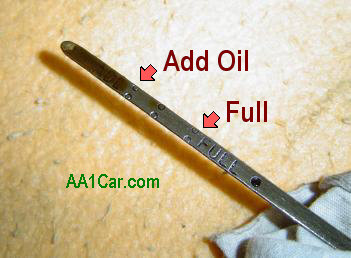
If the level is low (at or below the "ADD" line on the dipstick) add oil as needed to bring it up to the "FULL" mark, then inspect the engine for possible oil leaks.
If no oil leaks are found, start the engine and observe the tailpipe when you rev the engine. Blue smoke in the exhaust is a telltale symptom that your engine is burning oil.
Should you be concerned if your engine seems to be using too much oil? It depends on how much oil your engine is using, where the oil is going (leaking or burning), and how that might affect its operation and longevity.
An engine that burns oil will often foul the spark plugs. That, in turn will cause ignition misfire, higher emissions and a loss of fuel economy and performance. Such faults will usually trigger trouble codes that cause your Check Engine light to come on, and if the light is on your vehicle will not pass an emissions test.
The zinc and phosphorus anti-wear additives in motor oil can also foul the catalytic converter and oxygen sensors if your engine is burning oil. This too will set trouble codes and cause the Check Engine light to come on. Converters and oxygen sensors are vital components in your engine control system, and replacing them can be expensive.
If your engine is leaking oil because of a bad valve cover, oil pan, front cover or other gasket, or a leaky crankshaft or camshaft seal, the leak can be fixed by replacing bad gasket or seal.
Oil consumption inside your engine depends on two things: the valve guide seals and piston rings. If the valve guide seals are worn or damaged, or if there's too much clearance between the valve stems and guides, the engine will suck oil down the intake valve guides and into the cylinders. The engine may still have good compression, but will use a lot of oil.
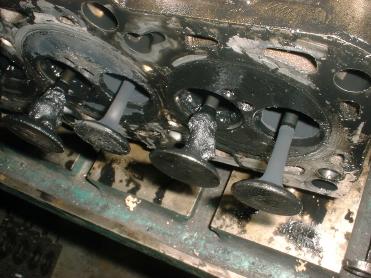
Most late model engines use some type of positive valve guide seal on the tops of the intake and exhaust valve guides. These seals all a tiny amount of oil to enter the valve guides to lubricate the valve stems and the valves move up and down. But they are supposed to limit the amount of oil that enters the guides so the engine does not consume excessive amounts of oil.
Over time, valve guide seals can wear and lose their ability to limit how much oil enters the guides. The problem is often worse on the intake valve guides because the intake valves are exposed to high engine vacuum every time the intake valves open. If an intake valve guide seal is worn, oil will be sucked down the guide and burned in the engine. Worn intake valve guide seals can increase oil consumption to a quart or more in 1,000 miles.
With exhaust valve guide seals, the situation is a little different. Exhaust guides run much hotter than intake guides, so the seals are subjected to higher temperatures. Over time, this accelerates wear and a deterioration of the guide material. Also, exhaust guide seals are exposed to pressure rather than vacuum every time the exhaust valves open. The outward flow of hot exhaust gases further accelerates seal aging and wear.
Replacing worn valve guide seals can dramatically reduce oil consumption in an older high mileage engine.

On older pushrod engines, you can remove the valve cover(s), remove the rocker arms, and use a spring compressor to remove the springs so new seals can be installed on top of the guides. To prevent the valves from falling down into the cylinders while this is being done, the cylinder can be pressurized with an air hose through the spark plug hole. Another technique is to remove the spark plug, slide a short length of rope into the cylinder and slowly rotate the crankshaft by hand until the piston in that cylinder is near Top Dead Center (TDC). The rope will hold the valves shut and prevent them from sliding down into the cylinder.
On overhead cam engines, replacing worn valve guide seals is not so easy because the camshaft sits on top of the valves. On some applications, it is possible to remove overhead camshafts without having to pull the cylinder head off the engine but is usually requires a special camshaft tool to hold the valves down while the cam is being slid out of the head. On most OHC applications, replacing the valve guide seals requires pulling the cylinder head off the engine for bench disassembly. This, in turn, means disconnecting the timing belt or chain, replacing the head gasket, head bolts and intake gaskets, and aligning the camshaft correctly when it is reinstalled so timing is correct (which is no simple job on some engines, and may require special tools!). In other words, it's a lot of work and expense, and not something you want to attempt unless you have a lot of knowledge and experience. This job is better left to a professional.
If the bronze or cast iron valve guides are worn, they cylinder head will have to be removed from the engine and completely disassembled so the old guides can be pressed out and replaced with new guides, reamed out and fitted with special bronze or iron liners, or machined to oversize to accommodate new valves with oversized stems.
The other cause of oil burning is worn or damaged piston rings that allow oil to get past the rings and into the engine's combustion chambers. All engines typically have three rings on each piston. The top ring is a compression ring. The bottom ring is the oil ring that carries and spreads a film of oil on the cylinder wall to lubricate the rings and reduce friction. Between these two rings is the all-important 2nd compression ring, which as we said earlier acts like a scraper when the piston moves down to scrape excess oil off the cylinder wall and push it back towards the oil pan.
In a high mileage engine, the top two rings will likely have the most wear and allow an increased amount of oil to get past the rings into the combustion chamber. This will cause an increase in oil burning and consumption as well as a loss of compression (which reduces engine power). The greater the ring wear, the greater the loss of compression and the greater the oil burning.
Worn piston rings can be diagnosed by performing a compression test and/or leakdown test on the engine to see how well the rings are sealing (or not).
All engines will experience a small amount of piston ring wear over time. However, if the engine is properly maintained (regular oil, oil filter and air filter changes), ring wear should be minimal even after 100,000 miles or more.
Dirty oil and dirty air can really accelerate ring and cylinder wear. If dirty air is sucked into the engine because of a missing or ill-fitting air filter) the hard abrasive particles act like sandpaper and wear the rings and cylinders. Driving on dusty rural gravel roads with a missing or leaking air filter can ruin the piston rings in an engine very quickly.
Some pickup trucks have had problems with plastic air filter housings that warp or do not seal tightly against the filter and allow dirty air to get past the filter.
Cheap poor quality air filters and oil filters from offshore suppliers that do a poor job of trapping smaller dirt particles can also contribute to accelerated engine wear (rings, cylinders and bearings). Our advice is buy brand name air and oil filters from reputable suppliers.
Engine detonation (spark knock) can also damage piston rings, and may cause the top and sometimes even the second ring to crack and break. This causes a loss of ring tension that is essential for proper ring seal while also opening up a second gap that allows compression to leak and oil to enter the combustion chamber.
Another cause of accelerated piston ring and cylinder wear can be an engine that runs too cold (somebody removed the thermostat or installed the wrong temperature range thermostat), or an engine that is running too hot (any cooling problem that prevents the engine from maintaining normal operating temperature).
Not changing the oil often enough can allow carbon deposits to build up around the rings, causing the to "stick" and prevent the rings from sealing.

If the piston rings are worn, you're looking at a major overhaul or engine replacement. Replacing a set of piston rings is no simple task. The engine has to be torn down and inspected to determine how worn the cylinders are, and whether or not the cylinders need to be reconditioned.
Over time, cylinders typically experience more wear in towards the top, developing a tapered wear pattern with more wear at the top than the middle or bottom. This happens because combustion temperatures and pressures are greatest when the pistons are near the top during the compression/power stroke.
If you just replace a worn set of rings with new rings and put the engine back together without checking the condition of the cylinders or reconditioning the cylinders, the new rings won't seal properly and the engine will still burn oil.
If the amount of taper wear in a cylinder is minimal (say no more than a four or five thousandths of an inch at the top), deglazing the cylinders with a hone to restore some crosshatch might be all that's required to get the new rings to seal. But in a high mileage engine with a lot of taper wear, or deep scratches in the cylinders, boring/honing the cylinders to oversize and installing a new set of oversized pistons and rings may be necessary.
Other repair options include sleeving worn cylinders (which requires the services of a machine shop), replacing the old engine block with a new or reconditioned block, or replacing your old engine with a new, used or remanufactured engine. These are all very expensive repair options so you should compare the economics of repairing your old vehicle versus the cost to buy another vehicle.
Oil burning can also occur if the cylinders in a newly rebuilt engine are not honed properly (too rough, too smooth, wrong crosshatch), or if the piston rings never fully seat. Auto makers plateau hone the cylinders so the rings will seat quickly. Plateau honing shaves the sharp peaks off the scratches in the cylinder wall after the initial honing so the finish will be similar to a broken-in cylinder. If the honing process is not done correctly, the rings may never seat. This is especially important on engines with aluminum alloy cylinders or hard coated (Nikasil) cylinders.
Also, many late model engines are factory-filled with low viscosity synthetic oil (5W-20, 0W-20, 0W-40, etc.) to reduce friction and improve fuel economy. Low viscosity oil is thinner so it can leak past rings and valve guide seals easier than heavier viscosity oils. Synthetic oil is a great lubricant for all types of driving but it is NOT a good break-in oil - especially if the cylinders were not honed properly.
Most aftermarket engine builders break-in new engines with a conventional non-detergent SAE 30W or 10W-30 motor oil or a special break-in oil. Once the piston rings have seated (a process that can take 45 minutes to an hour or more on a dyno, or several hundred miles of normal driving if the engine is broken-in in the vehicle), the break-in oil is drained and the engine is refilled with what ever oil will be used for normal driving (conventional or synthetic).
Excessive oil consumption in a new engine can also be caused by assembly mistakes. The piston rings may not seat or seal properly if the rings are installed upside down, twisted into the piston ring grooves (which will bend and distort the rings), or the installed ring end gaps are too large or are not staggered to reduce blowby.
There's no easy fix for improperly honed cylinders or incorrectly installed rings other than to rebuild or replace the engine - an expensive fix that most car manufacturers want to avoid. So if your new car dealer tells you high oil consumption is "normal," they are full of BS! A late model engine that has been honed and assembled correctly should use less than a half a quart of oil between normal oil changes (and that includes engines that specify oil changes every 5,000 to 7,500 miles!).
There are no "miracle" engine treatments or pills that will stop oil burning or magically restore worn cylinders and rings. But some crankcase additives can slow oil burning, although they won't stop it entirely.
There are also "high mileage" motor oils that are specially formulated with extra additives to slow oil consumption. Switching to a "high mileage" oil the next time you change oil may help reduce oil leaks and burning.
Switching to a heavier viscosity motor oil may also help reduce oil consumption. Try moving up one viscosity grade the next time you change oil. If your engine currently uses a 5W-20, switch to a 5W-30 or maybe a 10E030 oil. If you drive an older vehicle that uses 10W-30 oil, try a 10W-40 or possibly a 15W-40 or 20W-40 (but only for warm weather driving because 15W-40 and 20W-40 may be too thick for cold weather starting and lubrication).
If your engine is using oil because of a leak, the leak must be fixed to stop the loss of oil. Sometimes all that's necessary is to retighten the valve cover or pan gasket mounting bolts because they can loosen over time. But if the gaskets are crushed and have lost their elasticity, you will need new gaskets. Valve cover, timing cover and oil pan gaskets are usually not too difficult to replace, but leaky crankshaft end seals can require a lot of disassembly (particularly the rear main crankshaft oil seal).
If the engine is using oil because of worn valve guides or valve guide seals, it is possible to replace just the valve guide seals without having to remove the cylinder heads or overhaul the engine. New valve guide seals can drastically reduce oil consumption. I have seen older high mileage engines go from using a quart of oil every 500 miles to using no oil between oil changes (3000 miles) by simply replacing the valve guide seals!
when the piston is at top dead center. The rope will fill the void between the piston and valves to hold the valves in place while you change the seals.
Consumer Guide magazine surveyed data from 498,000 owners of 2010 to 2014 models and discovered that 98 percent did NOT have to add oil between oil changes. However, it also found that about two percent of these car owners had engines that were using a quart or more of oil between oil changes - which is too much for low mileage late model engines.
The engines that are using the most oil, according to the survey, are Audi A3, A4, A5, A6 and Q5 models with a 2.0L turbocharged four cylinder or 3.0L V6 engine, BMW 5, 6 and &-Series and X5 models with a 4.8L V8 or 4.L twin-turbo V8, and Subaru Outback, Legacy, Forester and Impreza models with a 3.6L six-cylinder, 2.0L four or 2.5L four.
Consumer Guide contacted these auto makers for their comments and were told that under certain conditions (racing maybe?) it was "normal" to burn a quart of oil every 600 to 700 miles said Audi and BMW, or 1,000 to 1,200 miles in the case of Subaru.
Audi reportedly has been slapped with a class action lawsuit over the excessive oil consumption. The models covered in the lawsuit include 2009 A4, 2010 A4 and A5, and 2011 A4, A5 and Q5 models.
Certain 2013 to 2015 Subaru Crosstrek, Forester, Legacy, Impreza and Outback models with 2.0L and 2.5L engines have experience excessive oil consumption problems. The problem has been blamed on defective piston rings that did not seal properly, causing the engines to consume more than a quart (liter) of oil in less than 500 miles. Subaru says that "normal" oil consumption on these engines may be one quart every 1,000 to 1,200 miles.
The oil consumption problem is covered under the Subaru powertrain warranty. If an engine is using an excessive amount of oil, Subaru will replace the engine short block assembly with a new one.
The Technical Service Bulletin covering this issue is TSB 02-157-14R. Contact your local Subaru dealer if you are experiencing an oil consumption problem.
Some owners of 2015 to 2018 Ford Mustang Shelby GT350 with the high-revving 5.2L Voodoo engine have reported unusually high oil consumption problems with their engines. In some cases, excessive oil consumption has led to a loss of oil pressure and engine failure.
The redline on this engine is 8,200 RPM, which means good ring seal is critical to prevent oil from getting past the rings. Apparently, some of these engines have experienced ring seating issues resulting in oil consumption of as much as a quart in a few hundred miles!
Some have blamed the excessive oil consumption issue on not breaking the rings in properly when the engine is new. Many experts recommend limiting engine speeds to no more than 5,000 RPM during the initial break-in period, doing a series of half to three-quarter throttle accelerations and decelerations to help seat the rings, and avoiding excessive idling or cruising at the same speed for an extended period of time until the rings have fully seated. The oil should also be changed after the first 1,500 miles of driving.
Although soe Ford dealers have told their customers that burning a quart of oil every 500 miles is "normal" the truth is no engine should use more than a quart of oil between oil changes (5,000 miles) regardless of how it is driven. If an engine is using more than a quart of oil every 1,000 to 1,500 miles, the piston rings are not sealing properly to control oil consumption.
As of this writing (May 2020), Ford has not issued a TSB on the GT350 oil consumption problem. Whether the fault lies with how the engine was built (possibly an improper cylinder bore finish from the factory, or defective piston rings), or the owner (improper engine break-in) is unclear. If the fault can be attributed to a manufacturing defect, it should be covered under Ford's powertrain warranty.
 Related Articles:
 Click Here to See More Carley Automotive Technical Articles