
Auto Repair Library, Auto Parts,
Accessories, Tools,
Manuals & Books, Car BLOG,
Links, Index

How to Use Brake Grease
by Larry Carley copyright AA1Car.com
When it comes to brake work, grease is essential. Brake greases are specially formulated products that are not the same as ordinary chassis grease or even multi-purpose grease. The kind of grease that is used to lubricate tie rod ends, ball joints and U-joints is not the same as the lubricants that are required for brake system components. In fact, ordinary grease may cause serious problems if it is used on brake hardware or hydraulic components.
One thing that makes the lubrication requirements for brake components different from that of steering and chassis components is heat. Brakes run hot. The front brakes on many front-wheel-drive cars and minivans, as well as trucks and SUVs, can easily reach several hundred degrees with normal braking, and get much, much hotter under certain circumstances. Riding the brakes in heavy stop-and-go traffic, mountain driving, aggressive driving, towing a trailer, or hauling a heavier-than-normal load can all increase the load on the brakes and the operating temperature of critical brake components.
At elevated temperatures, most ordinary chassis grease can't take the heat and will either melt or burn off, leaving surfaces unprotected and unlubricated. Worse yet, the grease may contaminate the brake linings if it melts and runs off the calipers or drum hardware. That's why high-temperature synthetic brake grease with a high solids (moly)is recommended for lubricating critical brake components.
Another reason for not using ordinary chassis grease or multi-purpose grease on brake components is because these products are usually petroleum-based. As every technician should know, many petroleum-based products are not compatible with the seal materials that are commonly used inside brake systems. For this reason, petroleum-based grease or oil should never come into contact with the rubber seals, pistons or other internal parts in a master cylinder, brake caliper or wheel cylinder. If it does, the entire brake system should be considered contaminated. This will require draining and flushing the entire system, and replacing all the major hydraulic components! Why? Because petroleum-based products can cause incompatible seal materials to swell, rupture and leak, which could lead to fluid loss and brake failure.
Brake grease, by comparison, are specially formulated products that are designed exclusively for brake applications and nothing else. The chemicals in these products are compatible with all commonly used seal materials, and will not harm these parts.
DIFFERENT TYPES OF BRAKE GREASE
Some brake lubricants are designed for lubricating hardware and mechanical components, and typically contain a high percentage of solids ("dry film lubricants"), and some are designed for lubricating seals, boots and other internal parts when assembling calipers, wheel cylinders and master cylinders.
Brake grease for hardware is a special high-temperature grease designed to provide long-lasting protection. The lubricant may be a synthetic or silicone-based product. Synthetic-based, "boundary-type" lubricants that come in a tube, paste or stick form have a high solids content and typically contain a variety of friction-reducing ingredients such as molybdenum disulfide ("moly" or MOS2) and graphite.
Moly and graphite are both dry-film lubricants that can handle high temperatures and pressures. Some of these products are rated to withstand intermittent temperatures as high as 2,400 degrees F! Moly and graphite have excellent staying power and won't evaporate or burn off over time, and they won't attract or hold dirt like ordinary "wet" greases can. This type of product is ideal for high-temperature applications where long-lasting, metal-to-metal lubrication is essential for good brake performance.
Silicone-based brake grease is designed for caliper and wheel cylinder assembly work because silicone is an excellent lubricant for rubber and plastic. It is compatible with all rubber compounds including nitrile, Teflon, nylon and other synthetic rubbers. Silcones normal working range is -40 degrees F to 400 degrees F. But it does not have the high-temperature staying power of a high solids synthetic lubricant, and it is a "wet" lubricant that can attract and hold dirt, making it less suitable for lubricating external metal-to-metal contact points such as caliper mounts and shoe pads. This type of product is best suited for assembling calipers, wheel cylinders and master cylinders.
Another synthetic-based brake lubricant uses polyalphaolefin (PAO) as its main ingredient. PAO-based brake lubricants are also excellent for assembly work and lubricating seals and boots. PAO offers superior rust protection, making it well-suited for brake systems operated in wet environments. PAO brake lubricant may also include various amounts of moly, graphite and Teflon to enhance its lubricating properties. This type of product can withstand intermittent temperatures of up to 600 degrees F, and can be used for both assembly and external lubrication.
White lithium is a low-temperature grease that can be used to lubricate drum brake hardware and backing plates, but lacks the heat-resistance for front disc brake applications. So it's not the best choice for general brake work.
Regardless of what type of brake lubricant you choose, always follow the supplier's recommendations as to how to use their product.
Where to Apply Brake Grease
Brake grease should be used at every point in the brake system where parts slide or move.
Disc brake lubrication points include the caliper slides, pins and bushings, the contact points where the pads slide within the caliper housing, self-adjuster mechanisms on rear disc brakes with locking calipers, and the parking brake cables and linkage.
WARNING: DO NOT apply grease to the front or friction side of the brake pads as this will contaminate and ruin the linings.
Brake grease can also be used to dampen vibrations between disc brake pads and caliper pistons. Apply a small mount of grease to the BACK of the pads and the face of the caliper piston where it contacts the pad. If a metal noise control shim is also used on the back of the pad, apply a small amount of grease to the side of the shim that faces the caliper piston. Use the grease sparingly - don't glob it on.


Drum brake lubrication points include the raised pads on the backing plates that support the shoes, the star adjuster mechanisms, hinge points for self-adjusters or the parking brake linkage, and the parking brake cables. Be careful not to get any grease on the friction surface of the brake shoes as thi8s will contaminate and ruin the shoes.
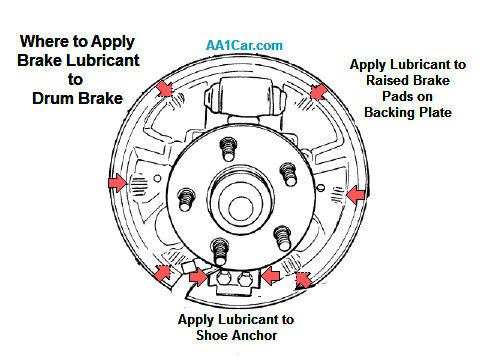
Grease-contaminated shoes or pads will be grabby and usually cause uneven braking and/or a pull to one side when the brakes are applies. The only cure is to replace the fouled linings with new ones. Cleaning is out of the question because solvents and cleaners can adversely affect the linings, too.
For lubricating hydraulic components such as the piston seals inside calipers and wheel cylinders, use a silicone-based brake lubricant or ordinary brake fluid. This type of lubricant will help assure smooth movement of the seals in their bores, and will help prevent these parts from sticking or corroding.
 More Brake Articles:
Brake Warning Light (possible causes)
Fixes For Common Brake Problems
Master Brake Cylinder
Low Brake Pedal (causes)
Brake Pad Installation Tips
Servicing Brake Hydraulics
Drum Brake Service
Drum Brake Wheel Cylinder Inspection & Service
 Click Here to See More Carley Automotive Technical Articles
Be sure to visit our other websites:

OBD2HELP
ScanToolHelp
TROUBLE-CODES