
Home,
Auto Repair Library, Auto Parts,
Accessories, Tools,
Manuals & Books, Car BLOG,
Links, Index

CV Joint and Boot Repair
Copyright AA1Car
Constant velocity joints (CV joints) are found on many cars and even some truck today. Though vehicle manufacturers are reintroducing rear-wheel drive on more new cars, over 80 percent of all the cars on the road today are front-wheel drive, and every one has four CV joints. Most minivans also have FWD, and most all-wheel drive (AWD) cars such as Subaru, Audi, Mitsubishi Eclipse and others have halfshafts (axle shafts) with CV joints both front and rear. The same goes for the rear axle shafts on a growing number of SUVs.
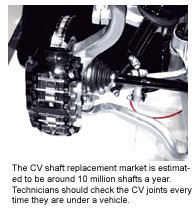
The CV shaft replacement market is estimated to be around 10 million shafts a year. According to aftermarket research, 92 percent of repair shops service CV joints and shafts, and do an average of 8.3 jobs per month. The average job ticket is $190.65, which implies one one axle shaft is being replaced, not both as if often recommended when a CV joint fails.
Replacing only one shaft is like a dentist replacing only half of a set of dentures. If a CV joint on a high-mileage vehicle has failed, chances are its twin on the opposite side is nearing the end of its service life, too, so both axle shafts should probably be replaced.
The outer CV joints are usually the ones that most often need to be replaced for two reasons. One is that the outer CV joints wear more than the inner CV joints because of the steering angles they experience. The other is that the boots on the outer joints are more apt to fail than the ones on the inner joints.

This CV joint boot has reached the end of the road and needs to be replaced.
CV JOINT BOOTS
A boot failure is bad news for any CV joint because it dooms the joint to premature failure. A split, cracked, loose or torn boot will throw grease, draining the joint of its vital supply of lubricant. Sooner or later the joint will run dry which is not a good thing for metal-to-metal surfaces that must withstand high pressure loads and constant friction. A boot that doesn't seal can also allow outside contaminants, such as road splash and dirt, to enter the joint and wreak havoc on its precision machined and polished surfaces. If the boot problem isn't discovered almost immediately, joint failure will usually follow within a few thousand miles.
As long as a CV joint remains sealed inside its protective environment, it will do its job until it wears out. But real world driving creates conditions that can cause bad things to happen to good boots. Age, heat, cold and road hazards can all conspire to breech the protective barrier provided by the boot around the joint. And once the seal is breached, trouble quickly follows. This is why you should always inspect the boots around both the inner and outer CV joints anytime you are under a vehicle for other maintenance or repairs.
Checking the CV joint boots should be part of every oil change, every brake job, every alignment job, every steering/suspension repair and every exhaust repair.
If your vehicle has a CV boot that is leaking grease, most repair shops today won't just replace th e boot. Why? Because chances are the CV joint
inside may be worn or damaged, especially if your vehicle has a lot of miles on the odometer. Most shops will simply replace the entire halfshaft with
a new or remanufactured shaft. Yes, it is more expensive than replacing a bad boot, but it is a far more reliable and long-lasting repair.
CV JOINT INSPECTION
Under normal operating conditions, CV joints and boots are engineered to last upwards of 150,000 miles. Some go the distance, but a lot reach the end of the road far short of their design life. According to one major aftermarket supplier of replacement axle shafts, CV joint shafts are typically being replaced at anywhere from 70,000 miles to 130,000 miles.
What's more, some makes and models of vehicles are notorious for eating shafts. Subaru, according to this source, is one vehicle that has a higher-than-normal replacement rate. The aftermarket supplier we talked to blamed the problem on the relatively thin case hardening that Subaru uses in their CV joints.
CV JOINT BOOT FAILURE
If you're lucky and catch a bad CV joint boot before any contamination or damage to the CV joint has occurred, you may be able to save the joint. The first thing you need to do is to check the grease inside for contamination. If it feels gritty, the CV joint will have to be cleaned and inspected before the boot is replaced. If the CV joint has lost its grease and is making noise, it is too late. The CV joint has failed and must be replaced.
Cleaning a CV joint while it is still on the vehicle is difficult. There are aerosol solvents and similar products for this purpose, and cleaning in place obviously saves the labor of pulling the shaft. But the shaft will have to come out anyway if you are replacing the damaged boot with a new one-piece boot. Split-boots are an option here, and save time because you do not have to remove the shaft or CV joint to replace the boot. But the seam must be glued carefully so it forms a leak-free seal.
A premium quality one-piece boot is the best alternative for replacing a damaged OEM boot. Premium CV joint boots made of materials other than neoprene or hard plastic typically retain greater flexibility at cold temperatures (making them less apt to crack), and can also withstand higher temperatures, too.
REPLACE CV JOINT
If you opt to replace a damaged boot, the CV joint should be removed from the shaft, disassembled and inspected for wear or damage. On most applications, the outer CV joint is held on the shaft by a snap ring or a lock ring, but some, such as Honda and Toyota can be tricky to remove. And if you run into a tripod outer CV joint on an old Toyota Tercel or Nissan Sentra, disassembly is not possible. The entire shaft assembly must be replaced.
Rzeppa-style CV joints can be disassembled by tilting the inner race to one side and inserting a dowel or similar tool into the splines of the inner shaft. Tilt the race as far as it will go to one side to expose one of the balls. Remove the ball from its cage window with a small screwdriver. The inner race can then be tilted to the opposite side so the next ball can be removed, and so on until all the balls have been removed. The cage can now be rotated sideways to remove it and the inner race.
Look for nicks, gouges, cracks, spalling, roughness, flaking, etc. on the surface of the balls or tracks in the inner and outer races. The cage windows should also be inspected for dimples, wear or cracks. Each ball should fit snugly in its respective cage window because looseness here is what often causes the clicking or popping noises associated with a worn CV joint.
NOTE: CV joints are precision fit assemblies. The balls should be kept in order so they can be reassembled in the same grooves and cage windows as before. Each ball and track develop a unique wear pattern, so don't mix them up.
If the CV joint shows no unusual wear or damage, it is OK to reassemble and repack with grease. Use the special CV grease provided with the replacement boot (never use any other type of grease!), and pack 1/3rd into the joint and place the remainder in the boot.
To install the boot, slip it onto the shaft (large end out). Then push the CV joint onto the shaft until it clicks in place or until the snap ring can be locked in place. Pull the outer lip of the boot over the CV joint housing so it lines up with the recess in the housing. Make sure the boot is not crimped, twisted or collapsed, then install the clamps. Some types of clamps require special tightening/crimping tools, while others do not.
SYMPTOMS OF CV JOINT FAILURE
Bad boots are not the only thing you need to look for. You also need to listen for noise or complaints that might indicate a CV joint problem. These include:
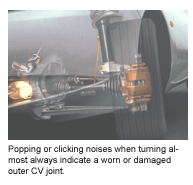
Popping or clicking noises when turning. This almost always indicates a worn or damaged outer CV joint. To verify this condition, place the vehicle in reverse, crank the steering wheel to one side and drive the vehicle backwards in a circle (check the rearview mirror first!). If the noise gets louder, it confirms the diagnosis and the need for a new CV joint or replacement shaft assembly.
A "clunk" when accelerating, decelerating or when putting the transaxle into drive. The noise comes from excessive play in the inner joint on FWD applications, either inner or outer joints in a RWD independent suspension, or from the driveshaft CV joints or U-joint in a RWD or AWD powertrain. The same kind of noise can also be produced by excessive backlash in differential gears. To verify the condition, back the vehicle up, alternately accelerating and decelerating while in reverse. If the clunk or shudder is more pronounced, it confirms a bad inner joint.
A humming or growling noise. Sometimes due to inadequate lubrication in either the inner or outer CV joint, this symptom is more often due to worn or damaged wheel bearings, a bad intermediate shaft bearing on equal length halfshaft transaxles, or due to worn shaft bearings within the transaxle.
A shudder or vibration when accelerating. May be caused by play in the inboard or outboard joints, but the most likely cause is a worn inboard plunge joint. Similar vibrations can also be caused by a bad intermediate shaft bearing on transaxles with equal length halfshafts, or by bad motor mounts on FWD vehicles with transverse-mounted engines.
A vibration that increases with speed. This symptom is rarely caused by a failing CV joint. An out-of-balance tire or wheel, an out-of-round tire or wheel, or a bent rim are the more likely causes.
CV JOINT REPLACEMENT TIPS
Since most technicians today opt to replace the entire shaft rather than individual CV joints, here are some suggestions that can help avoid problems later:
Make sure you have the right replacement CV joint or shaft for the vehicle. Chrysler FWD and Honda use CV joints from various suppliers, so be sure the replacement joint has the same length, shaft diameter and spline count as the original.
On Chrysler FWD cars and minivans, the transaxle must be centered so both shafts will have the proper amount of travel as the suspension moves up and down. The exact dimensions can be found in a service manual. The position of the transaxle can be moved by adjusting the right side motor mount.
When replacing the driveshafts on an older Ford FWD car (Escort, Lynx, Tempo & Topaz) with an automatic transaxle, replace the shafts one at a time or insert a transaxle plug or similar tool to prevent the differential side gears from slipping out of place. If the gears have slipped, remove the transaxle pan and push against the side gear to move it back into position. Then hold it in place with a plug or similar tool to prevent it from slipping until the driveshafts can be reinstalled.
The same precaution must be used on older Nissan FWD cars (Stanza & Maxima) with an automatic transaxle. On these applications, the right axle shaft must be removed first. When the right axle has been pried out, insert a drift or screwdriver through the differential assembly to push out the left shaft. Then insert a bar into each side of the differential to prevent the side gears from slipping out of position.
On all vehicles equipped with ABS, the tone ring for the front wheel speed sensors is often located on the outer CV joint housing. If the joint or driveshaft is being replaced, make sure the replacement has the proper tone ring. An air gap adjustment may also be required for the speed sensor. Use a nonmagnetic brass or plastic feeler gauge to set the speed sensor air gap to specs.
Check the transaxle oil seals for leaks before the driveshaft is replaced. If they need attention, now's the time to fix them.
Replace the hub nut. Prevailing torque nuts lose their ability to stay tight once they are removed. The same goes for nuts that have to be staked in place. Most replacement shafts come with a new hub nut, but some new CV joints may not.
Use a torque wrench to tighten the ball joint and hub nut - never an impact wrench. Install new cotter pins and lock nuts if used. Most manufacturers also recommend replacing any suspension nuts that were removed with new fasteners.
Test drive the vehicle after the installation to make sure everything iws working properly (no noise, vibrations, etc.)
 More Front-Wheel Drive & CV Joint Articles:
CV Joints & FWD shafts, part 1: Basics
CV Joints, part 2: Service & Repair
How CV Joints are Remachined
Transmission-Related Articles
 Click Here to See More Carley Automotive Technical Articles
Be sure to visit our other websites:

OBD2HELP
ScanToolHelp
TROUBLE-CODES