
Home,
Auto Repair Library, Auto Parts,
Accessories, Tools,
Manuals & Books, Car BLOG,
Links, Index
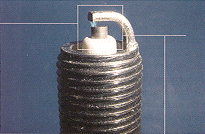
All About Spark Plugs
Copyright AA1Car.com
Spark plugs have been around almost as long as the internal combustion engine. In 1902, spark plugs were first used with a high voltage magneto to provide reliable ignition. For the next 70 years, spark plugs were a high maintenance item thanks to tetraethyl lead, which was used as an octane-boosting additive in gasoline. Unfortunately, lead tended to foul spark plugs after 12,000 to 15,000 miles of driving. Consequently, tune-ups and spark plug changes were an annual ritual for most motorists.
Then came the Clean Air Act of 1970, followed by new emissions regulations and the introduction of catalytic converters in 1975. Leaded gasoline was gradually phased out because of its damaging effects on converters as well as the environment. As a result, spark plug life more than doubled.
In the mid-1980s, spark plug manufacturers started making plugs with copper core center electrodes. Copper is an excellent conductor of heat and allows plugs to run hotter without causing preignition. This improves fouling resistance, ignition reliability and plug life. It also reduces the number of plugs needed to cover a range of engine applications because each plug has a broader "heat range."
The biggest improvement in spark plug technology, though, came in 1985 when the first generation "long life" plugs with platinum or gold-palladium electrodes hit the market. Up to this point, electrode wear usually dictated when a set of plugs had to be replaced. With standard nickel alloy electrodes, the spark gap between the center and ground electrodes grows about .0002" to .0006" for every 1,000 miles of driving. After 35,000 miles of driving, the gap can grow as much as 0.015" or more.
Every time a spark plug fires, the hot spark blasts a few molecules of metal off the electrodes. As the miles add up, the electrode gap widens and the center electrode becomes rounded and dull. This increases the firing voltage needed to jump the gap. Eventually the point is reached where the ignition system can't generate enough juice to jump the gap, causing the plug to misfire.
With platinum, gold-palladium and iridium (more on this in a minute), electrode wear is greatly reduced. Most platinum plugs can go up to 100,000 miles before they have to be replaced. The same is true for plugs that use iridium for their center electrode. Plugs with platinum or iridium on both electrodes ("double" platinum plugs or double iridium plugs) experience even less wear than plugs with only a single platinum or platinum-tipped electrode.
Long-life spark plugs drastically reduce the need for maintenance while helping the engine maintain like-new performance and emissions. Not having to change the plugs so often is a real savings for the vehicle owner, but it's no guarantee the plugs will go the distance.
Platinum & Iridium Spark Plugs
Long-life spark plugs by ACDelco, Autolite, Bosch, Champion, Denso,NGK, and Split-Fire all have platinum or iridium electrodes.
With a couple of exceptions, platinum plugs use a conventional electrode configuration with a small platinum plug welded to the tip of the center electrode (single platinum) or the tip of the center electrode and ground electrode (double platinum). ACDelco also offers a platinum version of its "Rapidfire" plug that features a fluted center electrode for improved ignition reliability. Likewise, Split-Fire offers a platinum version of its split electrode plugs for motorists who want extended life as well as reduced misfiring. By comparison, iridium plugs have a small wire center electrode, and like platinum plugs may be single iridium (center electrode only) or double iridium (center and ground electrodes).

Bosch, who introduced the first platinum plug back in 1985, offers several different electrode configurations in their product line. Their standard platinum plug has a thin pure platinum center electrode with a single yttrium-alloy end electrode. Their Platinum+2 and Platinum+4 plugs, on the other hand, have a unique "surface gap" side electrode design with two side electrodes on the Platinum+2 plug and four on the Platinum+4 - a sort of good, better, best approach to platinum plug technology. Increasing the number of side electrodes gives the spark more paths to ground and reduces the risk of misfire, while extending plug life by spreading wear over more electrode surfaces.
In the fall of 2006, Bosch introduced yet another long-life spark plug called Platinum IR Fusion. Similar in design to the Platinum+4 plug, this plug uses a center electrode made of a unique iridium/platinum alloy. The four side electrodes are a wear-resistant yttrium alloy. By combining platinum and iridium in the center electrode, Bosch says their Platinum IR fusion plug provides even longer service life (probably the longest of any spark plug that is currently available). Bosch also says their new Platinum IR Fusion plugs are an ideal replacement for any engine that comes originally equipped with either iridium spark plugs or platinum spark plugs.
One important point to keep in mind with respect to Bosch Platinum IR Fusion, Platinum+4 and Platinum+2 plugs is that these plugs are pre-gapped at the factory to a uniform 1.6 mm setting and should not be re-gapped to the specifications for a standard spark plug. It's very difficult to get even spacing with multiple electrodes so install them without changing the electrode gaps.
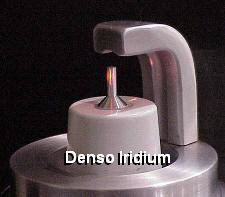
Although platinum spark plugs have many performance advantages over conventional spark plugs, iridium spark plugs offer even more advantages. The most important advantage is the longest service life of any spark plug (up to 4X longer than a standard spark plug, or 120,000 miles for many applications. Iridium last so long because the metal alloy is even more wear resistant than platinum. Iridium is usually alloyed with rhodium, creating a center electrode that is six times harder and eight times stronger than platinum. It is also one of the densest metals known.
Iridium has a melting point of 4370 degrees F (2410 degrees C), which is almost 1,200 degrees higher than platinum. It is a precious metal like platinum, which makes it expensive. But currently iridium sells for about half the cost of platinum ($540 ounce for iridium versus $1200 ounce for platinum November 2014).
NGK "Iridium IX" and Denso brand "Iridium Power" plugs are used as original equipment in many Asian vehicles. On late-model Toyota and Lexus applications, the OEM-recommended replacement interval for Denso iridium plugs is 120,000 miles. Autolite Iridium XP plugs are targeted at the aftermarket as a replacement for other brands of original equipment spark plugs, and feature a 0.6 mm fine wire center electrode.
All brands of iridium plugs typically have a very thin (0.4 mm to 0.7 mm depending on the plug) center electrode. On first generation Denso iridium plugs, the end electrode has a "U-Groove" that improves ignition reliability and wear resistance. Denso says their design reduces the required firing voltage up to 5,000 volts compared to a standard spark plug. Others, such as Bosch use a taper ground ground electrode with a laser-welded iridium-platinum inlay to minimize electrode wear.
For performance applications, Denso has also developed Iridium Power plugs with a super narrow 0.4 mm center electrode. These plugs are engineered to improve ignition reliability under extreme driving conditions.
In 2014, Denso introduced their new Iridium TT spark plug with an iridium/rhodium alloy center electrode and platinum tipped ground electrode. The Iridium TT spark plug center electrode has a 0.4 mm needle tip, composed of a patented iridium/rhodium alloy that offers exceptional protection against corrosion and high-temperature oxidation. The ground electrode also has a 0.7 mm platinum button that is designed to resist oxidation and wear. These small electrode tips reduce the firing voltage needed to create a spark, which reduces misfires. They also create less interference for the ignition flame to expand and fully complete the combustion process, according to Denso. The twin tips extend plug life and help concentrate the spark for improved combustion efficiency and reduced misfires.

The use of iridium spark plugs as original equipment in late model vehicles has grown considerably in recent years due to its performance and cost advantages. Iridium plugs are often used in engines with Gasoline Direct Injection for improved ignition reliability. Iridium spark plugs have also become a good upgrade option for replacing standard spark plugs or platinum spark plugs in older engines, too.
Where does iridium come from? Much of it came from outer space according to Denso. Approximately 50 million years ago, a giant asteroid smashed into our planet near the Mexican town of Chicxulub in Yucatan. The impact created a firestorm and dust cloud that darkened the Earth for years, wiped out the dinosaurs and left us with a layer of iridium-rich deposits that is evenly spread across every continent (the "K/T boundary" layer). Iridium is often combined with platinum in mineral deposits, and is recovered as a byproduct of nickel mining.
Spark Plug Electrode Designs
Spark plug manufacturers tout the advantages of their unique electrode designs, but regardless of the design, the purpose is to make it as easy as possible for the plug to fire reliably. A spark jumps more easily from a sharp edge than a rounded blunt edge. So the more sharp edges it has to jump to, the better the odds of the plug firing under all types of driving conditions. The electrodes on some spark plugs are also designed to "unshroud" the spark so more of the spark will be exposed to the air/fuel mixture. This improves the propagation of the flame kernel once the fire is lit.
One thing to keep in mind with respect to performance claims is that no spark plug creates horsepower out of thin air. A special electrode configuration can reduce misfiring and the voltage needed to fire the plugs. But the spark only ignites what is already in the combustion chamber. If there are any power gains to be had, they will be the result of reduced misfires and nothing else.
Ruthenium Spark Plugs
The latest development in spark plug technology is Ruthenium Spark Plugs. Electrodes made of a special ruthenium alloy are said to last 2X longer than current iridium spark plugs, and 4X longer than standard nickel electrode spark plugs. The increased wear resistance of the electrodes means these plugs may truly become "lifetime" spark plugs that never need to be replaced. They are also said to offer better ignitability for improved performance, emissions, fuel economy and acceleration.

NGK RUTHENIUM HX Spark Plugs
Spark Plugs Getting Smaller
Another trend in the ongoing evolution of spark plugs is that plugs are shrinking. The Ford Triton engines use long-reach 10 mm plugs from Autolite, which are 4 mm skinnier than the 14 mm plugs you're used to seeing in most late-model engines. The threads on these plugs are also 1-3/8" above the end of the plug, so heat has a long ways to travel before it can be dissipated through the threads into the cylinder head. This requires a couple of tricks to manage heat. One is an unusual "U" shaped end electrode that wraps all the way over the end of the plug. Connecting both ends of the electrode to the plug shell creates two paths for heat to flow away from the tip. The end electrode is made of a special high temperature Inconel alloy. In the center of the "U" is a small platinum pad to reduce electrode wear when the plug fires. The center electrode is also platinum tipped and has a copper core to help pull heat away from the tip.
Autolite is also marketing a "Titanium" spark plug. It's actually a standard spark plug with platinum tipped electrodes, but with a special titanium coating on the shell that resists seizing to reduce the risk of thread damage when changing plugs in aluminum cylinder heads.
Spark Plug Fouling Resistance
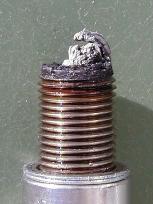
One thing all types of spark plugs must do is resist fouling. The trick here is to keep the electrodes hot enough to burn off fouling deposits but not so hot that they cause preignition. To burn off carbon deposits, the center electrode needs to reach about 700 degrees F quickly. But if it gets too hot (above -1,500 degrees F depending on the plug design), it may ignite the fuel before the spark occurs, causing preignition and detonation. For most plugs, the ideal operating temperature is around 1,200 degrees F.
The temperature of the electrodes is controlled by the length of the ceramic insulator that surrounds the center electrode and the design of the electrode itself. Ceramics do not conduct heat very well, so an insulator with a relatively long nose will conduct heat away from the electrode more slowly than one with a relatively short nose. The longer the path between the electrode and the surrounding plug shell, the slower the rate of cooling and the hotter the plug.
A spark plug's "heat range" (heat rating), depends on the length of the ceramic insulator and the design of the center electrode. The heat range must be carefully matched to the engine application otherwise the plugs may experience fouling problems at idle or run too hot under load causing preignition and detonation. Most plugs today have a relatively broad heat range thanks to the copper core center electrode described earlier. This allows the plugs to reach a self-cleaning temperature quickly and also prevents them from overheating.
Spark Plug Misfires
The voltage required to produce a spark can range from as little as 5,000 volts to as much as 30,000 volts or higher. The actual firing voltage will vary depending on operating conditions such as engine load, rpm, temperature, compression and the richness or leanness of the air/fuel mixture. The wider the electrode gap and the greater the load on the engine, the more voltage it takes to fire the spark plugs. Likewise, the higher the resistance in the spark plugs and plug wires, the higher the required firing voltage.
A cylinder may misfire if the spark never reaches the plug due to excessive resistance or breaks in the insulation in the plug wires, or a buildup of oxide, cracks or an excessively wide air gap inside a distributor cap. A weak coil or a faulty ignition module that doesn't give the coil enough time to fully charge between firings also can reduce the available firing voltage to the point where the spark may be too weak to jump the electrode gap. Of course, worn or dirty spark plugs also can make an engine hard to start, idle roughly, lack smoothness, waste fuel and pollute, too.
The most common cause of ignition misfire at the spark plug is fouling. A buildup of fuel and oil residue or other contaminants on or around the plug's electrodes can short out the spark before it reaches the gap. Contaminants also can form a barrier that blocks the gap or requires more voltage to punch through than the ignition system can deliver. The contaminants come from fuel additives as well as oil that gets past the rings and valve guide seals. A high-mileage engine with worn rings, cylinders and/or valve guides will often have a plug fouling problem.
On 1996 and newer vehicles with OBD II, ignition misfire will usually set a fault code and turn on the Check Engine light. Fuel that isn't burned causes a huge increase in hydrocarbon emissions and will usually cause a vehicle to fail an emissions test. Unburned fuel also can damage the catalytic converter by causing it to overheat. So if you find a cylinder-specific misfire code such as P0302 (indicating cylinder #2), check the spark plug, plug wire, coil (if it's a DIS or coil-on-plug system), fuel injector and compression to isolate the cause. On the other hand, if you find a random misfire code (P0300), the problem probably is not the ignition system. It's likely a lean fuel mixture caused by a vacuum leak or dirty injectors.
Reading Spark Plugs
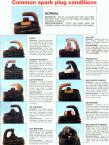 Click on image to view Spark Plug Diagnosis Chart.
Reading the condition of the old spark plugs can reveal a lot about other problems that may be going on inside the engine, things like lean fuel mixture, rich fuel mixture, oil burning, overheating, overadvanced ignition timing, detonation/preignition and more. Replacing the spark plugs will not solve any of these problems, and the new spark plugs will likely suffer the same kind of fouling, wear or damage unless the underlying problem is diagnosed and repaired.
Replacing Spark Plugs
As a rule, replacement spark plugs should have the same or better service interval as the original plugs. The brand does not matter, though many vehicle owners and technicians prefer to use the same brand of spark plug as the original when they replace plugs.
Long-life platinum and iridium spark plugs cost more than standard spark plugs but are an excellent upgrade for engines that were not originally equipped with these types of plugs. Most late model engines, however, come factory-equipped with long life platinum or iridium spark plugs.
If your engine has been fouling spark plugs, the plugs that you are using may be too cold for your kind of driving. Switching to a plug with a slightly hotter heat range may be necessary o solve a fouling problem. Fouling can occur if a vehicle is not driven very often or is not driven long enough or fast enough to keep the spark plugs clean.
For performance applications, switching to a slightly cooler spark plug can reduce the risk of pre-ignition and detonation at high rpm and loads.
When you change your spark plugs, wait until the engine has cooled. Trying to remove spark plugs from a hot aluminum cylinder head increases the risk of stripping the plug threads in the head. If a plug sticks or binds as you try to remove it, spray some WD-40 around the base of the plug, wait a few minutes, then turn the plug back in. Then slowly try to back it out again. Repeat as needed each time it binds until the plug eventually comes out. If you try to force it out, you will probably damage the threads in the head.
NOTE: Many late model overhead cylinder heads have very deep spark plug wells in the head. An ordinary spark plug socket may not work well to remove
such spark plugs, even with an extension attached. Various aftermarket tool suppliers have created special extra long deep well spark plug sockets as well as
sockets that have a long swivel extension permanently attached to the socket. This makes it much easier to loosen and tighten these types of spark plugs.
Another tip for removing/installing spark plugs that are located in a deep well in the cylinder head is to use a 8 to 10 inch length of rubber fuel hose or similar tubing to
grip and maneuver the spark plug as you thread the spark plug into the well or remove it after it has been loosened.
Choosing Racing Spark Plugs
Selecting the proper spark plugs for a performance engine can mean the difference between front of the pack and not finishing the race. When using this guide, understand that race plugs are usually of a much colder heat range rating than standard automotive spark plugs. Colder spark plugs must be used in engines with increased cylinder pressures, higher temperatures and greater horsepower. Other factors such as fuel delivery (turbo, supercharged), fuel types and piston-to-head clearance will also affect proper plug selection.
Step 1: Shell Design - The first step in choosing the proper race spark plug is determining the plug type that your cylinder head/piston will accept. Thread diameter and pitch, thread length and shell seat, as well as hex size are all factors that will define what shell type works best for your engine.
Step 2: Electrode Design - The second decision is electrode design and configuration. Is it a fine wire center or standard electrode? Projected or non-projected? Full coverage 'J-Gap' or perhaps a cut-back or angled ground wire? A good rule of thumb is to attain as much projection into the cylinder as possible. But be aware of piston clearance that could prohibit projected spark plugs from being used.
Step 3: Heat Range - The third factor in choosing a race plug is heat range. Correct heat range is critical in maintaining peak performance throughout the duration of your race or event. Switching to a colder or hotter plug will not increase horsepower, but could affect engine performance. Choosing a plug that is too hot can result in preignition or detonation. A plug that is too cold could cause an engine to stumble, misfire or foul.
The main factors to consider in selecting the proper heat range are: type of race, methanol, specific output, nitro-meth, compression ratio, nitrous oxide, horsepower, super or turbo charging and racing fuel.
Courtesy: Champion Spark Plugs
Spark Plug Replacement Tips
- Before you install any spark plug, compare the old and new plugs to make sure the replacement spark plugs have the same thread diameter, pitch (SAE or metric), thread length and seat configuration as the original plugs.
- On engines with aluminum heads, let the engine cool before you attempt to loosen and remove the plugs. This will reduce the risk of damaging the threads in the cylinder head.
- Always inspect the old spark plugs after they have been removed and note any conditions that would indicate a cylinder is running rich, lean or is burning oil.
- Spark plug wires should also be inspected - and replaced if the insulation is damaged, if resistance exceeds factory specifications or the boots are loose.
Courtesy NGK Spark Plugs (USA), Inc.
Spark Plug Torque and Gap Recommendations

Spark plugs come pregapped from the factory, but because of parts consolidation the factory gap may not always the specified gap for your engine.
Always refer to the specified electrode gap on your engine emissions decal. This typically ranges from .028 to .034 inches. Wider gaps are often required for
leaner air/fuel mixtures, but if the gap is too wide it increases the risk of misfire when the engine is under load.
On Bosch Platinum+4 and Platinum2 spark plugs, DO NOT change the factory electrode gap regardless of what the gap specification is for your engine.
The Bosch plugs come with a 1.6-mm gap, which Bosch says works for ALL applications with their unique spark plug design.
How much the spark plugs should be tightened depends on the size of the plugs and the type of plug seat. Spark plugs with gasket-style seats require more torque than those with taper seats. Always follow vehicle manufacturer torque recommendations, but as a general rule:
As a general rule 14 mm thread plugs (5/8 and 13/16 inch hex socket) with a gasket style seat in engines with CAST IRON should be tightened to approximately 18 to 25 lb-ft (24 - 34 N.m).
On engines with ALUMINUM cylinder heads, spark plugs with 14 mm threads and flat seats with gaskets (5/8 or 13/16 inch hex socket) should only be tightened to 18 - 21 lb-ft (24 - 28 N.m).
When installing spark plugs that have TAPERED seats with NO GASKETS, 14 mm thread plugs should be tightened to 7.5 to 14.5 lb-ft (10 - 20 N.m) in engines with ALUMINUM heads, and 11 - 18 lb-ft (15 - 24 N.m) in engines with CAST IRON heads.
If you are not sure how much to tighten the spark plugs, look up the specifications online or in a service manual. Torque specs will vary with plug thread diameter and application. Spark plugs with larger diameter threads (18 mm) typically require a little more torque while spark plugs with smaller diameter threads (10 and 12 mm) usually require less torque.
12mm spark plugs with flat seats and gaskets should be tightened to 11 to 18 lb-ft in CAST IRON heads, and 11 to 14.5 lb-ft in ALUMINUM heads.
12mm spark plugs with TAPER seats (no gaskets) should be tightened to 7 to 14 lb-ft in engines with ALUMINUM heads.
10mm spark plugs with TAPER seats (no gaskets) should be tightened to 7 to 9 lb-ft in engines with ALUMINUM heads, or 7 to 11 lb-ft in engines with CAST IRON heads.

 Ignition Related Articles:
Ruthenium Spark Plugs
Don't Neglect the Spark Plugs
Why Spark Plugs Still Need To Be Replaced
Spark Plug Fouling
Don't Use Ordinary Spark Plugs with Waste Spark DIS Ignition Systems
Bosch Platinum +4 Spark Plugs
Original Equipment Spark Plugs, Are They Best?
Ford Motorcraft Spark Plug Breakage Problem (2004 - 2008 Ford Trucks w/5.4L V8, & 2005 - 2008 Mustang GT with 4.6L V8)
Spark Plug Wires
Ignition Misfires
Troubleshoot Engine Misfires (P030X codes)
Spark Plugs & Ignition Performance
Distributor Ignition Systems
Distributorless Ignition Systems
Coil-Over-Plug Ignition Systems
Multi-Coil Ignition Systems
Diagnosing An Engine that Won't Crank or Start
Troubleshooting Intermittent Engine Problems
Test Your Knowledge: Ignition System Quiz
 Click Here to See More Carley Automotive Technical Articles
Be sure to visit our other websites:

OBD2HELP
ScanToolHelp
TROUBLE-CODES
