
Copyright AA1Car.com
CarMD's 2026 Vehicle Health Index analyzed failures across more than 39 million US vehicles in calendar 2025 and put the average check-engine-light repair at a record $554. That's up 33% in a single year.
The headline isn't the interesting part. The split is. In CarMD's full report, the average repair breaks down to $222 in labor and $332 in parts. A year earlier it was $147 and $269, a total of $416. Labor went up 51%. Parts went up 23%.
CarMD puts the labor jump down to more time-intensive procedures on increasingly complex systems. In its own words, "what used to be simple repairs, now often require more diagnostic time, specialized tools and advanced skills."
For a shop, that means one thing. The fastest-growing cost line in the trade is the one more than half of shops are giving away.
Here's the uncomfortable part.
The 2026 Ratchet+Wrench Industry Survey, built on more than 430 responses from shop owners and managers, found that 54% of shops don't charge for diagnostic work at all.
And the hour they're giving away isn't cheap. PartsTech surveyed 752 US auto repair shops for its 2025 benchmark report, and almost half of them price labor between $120 and $159 an hour.
There is a good argument that a diagnostic hour is worth more than a door-rate hour, not less. It ties up a scan tool, a lift and your most experienced tech, and the thinking time doesn't fit neatly into book hours.
So run the math on your own shop. Here's a simple version you can swap your numbers into:
15 check-engine jobs a week
1 hour of diagnosis on each
$132 an hour, a rate inside that common band
None of it billed
That's 15 × 1 × $132 = $1,980 a week. Over 52 weeks, it's $102,960 a year, just under $103,000.
That's not a rounding error. It's a six-figure line that never appears on a single invoice.
Why does diagnosis go unbilled so often? Part of the answer is in how labor guides work.
Most labor guides publish the time to perform the repair once the fault is already known. They don't cover finding it. Mitchell 1 is explicit about this: in its labor times FAQ, "Diagnosis (unless indicated)" is listed among the operations not considered when setting its labor times.
That's exactly why diagnosis has to be its own line on the repair order. If it's folded into the operation, it disappears. The guide time covers the repair, the customer pays for the repair, and the hour spent finding the problem goes nowhere.
Even before diagnosis enters the picture, the published times don't agree with each other.
A repair time comparison submitted to the Minnesota Senate in 2023 lists a steering shaft repair at 2.1 hours using ALLDATA's customer-pay time, against 0.8 hours under manufacturer warranty. That's a 62% spread on the same job. Mitchell 1's own FAQ gives a similar example: a 2015 Toyota Prius steering column R&R at 2.2 hours under Toyota warranty, against 5.3 hours in Mitchell 1.
It's no secret that published times for the same job can already differ by more than double. Then the technician does the job and clocks whatever it actually took. That's three numbers for one repair, and diagnosis isn't in any of them.
Take a P0171 as the example. AA1Car's lean code reference lists the usual suspects on a Ford alone: a vacuum leak, a dirty MAF sensor, an EGR valve that isn't closing or a faulty DPFE sensor, a weak fuel pump, low voltage to the pump, a restricted fuel filter, a leaky fuel pressure regulator or dirty injectors.
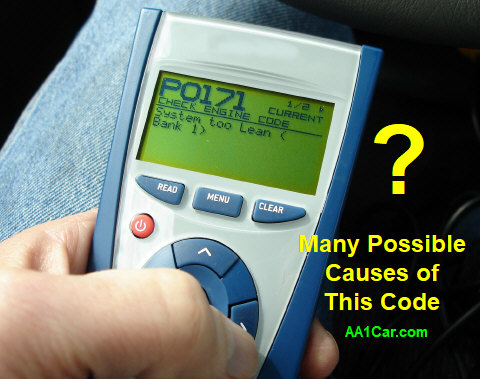
That's the point. The code is a symptom with a dozen possible causes.
Getting from the code to a confirmed fault means reading fuel trims at idle and under load, checking MAF readings against spec, smoke testing the intake, testing fuel pressure and volume, and maybe pulling injector data. Some of those take ten minutes. A small vacuum leak hiding under an intake manifold can take most of an hour.
Then the repair goes on the ticket. Say it turns out to be a cracked PCV hose with 0.4 hours in the guide. The customer sees a small, fair bill. The shop sees a technician who spent an hour and a half on a job that paid 0.4.
Here's the other problem: in a shop without job-level time tracking, nobody can see how often this happens. The hour a technician loses on a P0171 isn't written down anywhere. It just shows up, months later, as an efficiency number that's lower than it should be.
Tracking guide hours against what the technician actually clocked is a system function, not a clipboard function. Shops running auto repair labor guide software pull labor times into the estimate and record actual time against them on the same repair order. That makes the gap between the two visible per job, instead of invisible across the year.
The P0171 isn't alone. A handful of diagnostic paths regularly run well past book time.
Oxygen sensor codes. Before you can test a sensor, you have to be sure which one the code means. Bank and sensor numbering changes with engine layout, as AA1Car's oxygen sensor location reference shows across inline, V6 and V8 engines, and it's easy to get wrong. Testing the wrong sensor is time nobody bills.
Air conditioning complaints. "AC blows warm" can mean a refrigerant leak, a compressor that isn't engaging, a variable displacement control problem or a blend door issue. Working through it properly, the way AA1Car's AC diagnostic guide lays out, means pressure readings, leak checks and electrical tests before anyone touches a part.
Intermittent electrical faults. A fault that won't show itself in the bay can take longer to find than any repair in the guide.
Each one has a guide time for the repair. None of them has a guide time for the hunt.
Charging for diagnosis comes down to a decision about who you want as customers.
A shop that charges a diagnostic fee will lose some price shoppers on the phone. That's real. But the customers it keeps are mostly the ones who were going to approve the work anyway, because they want the car fixed properly rather than cheaply.
The shops absorbing diagnosis to stay competitive on the phone aren't winning those calls for free. They're subsidizing the hour that costs them the most to deliver.
 Click Here to See More Carley Automotive Technical Articles