
Home, Auto Repair Library, Auto Parts, Accessories, Tools, Manuals & Books, Car BLOG, Links, Index
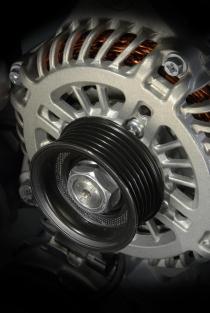
Your voltage or charging system warning light is on and your battery is dead or low because your alternator is not working. A quick voltage check at the battery terminals shows the charging system is not producing any voltage when the engine is idling. Assuming the problem is a bad alternator and not a problem elsewhere such as loose or corroded wiring connections, loose or corroded battery cables, or a fault in the charging control module or PCM, you need to replace your alternator.
Replacing an alternator is not a difficult job on most vehicles. All you need are some basic hand wrenches or sockets to loosen the alternator mounting bolts.
To replace your alternator, proceed as follows:

1. Disconnect your battery. NOTE: If you have a 2004 or newer vehicle, see the related article on Battery Disconnect Precautions.
Use a battery memory saver if the modules in your vehicle would be affected BEFORE you disconnect the car battery.
The reason for disconnecting your battery is to prevent any shorts or grounds that might occur if you accidentally touch a battery
positive wire at the alternator against anything metal. The sudden voltage surge could damage sensitive electronics in your vehicle or the wiring. There is NO danger of being shocked by 12 volts.

2. Remove the alternator drive belt.
On newer vehicles with a serpentine belt and automatic belt tensioner, locate the belt tensioner and use a socket and long handle to rotate the
tensioner. the direction you turn the tensioner will depend on how it is mounted and how the belt is routed. On vehicles where the tensioner is hard to reach, you may have to do this from underneath the vehicle, or it may
require using a special long handle serpentine belt tensioner tool.
NOTE: Before you remove a serpentine belt, look for an underhood decal that shows how the belt is routed. If you can't find such a decal, draw
a picture of how the belt is routed, or take a digital photo so you can refer to it later when you put the belt back on. The routing of some belts
can be very confusing, so make sure you know how it is supposed to be routed BEFORE you take it off.
If your vehicle has a serpentine belt for the alternator but there is no automatic tensioner, use the same removal procedure for a V-belt
(loosen the alternator pivot bolt and adjustment bolt, rotate the alternator inward to loosen the belt, then remove the belt).

On older vehicles with a V-belt, loosen the alternator pivot bolt and the adjustment bolt on the alternator support
bracket. Swing the alternator inward to relieve tension on the V-belt, then slip the belt off of the pulley.

3.Disconnect the wiring from the back of the alternator. In some instances it may be easier to disconnect the wiring after the alternator
bolts have been removed and you can turn or rotate the alternator for easier access. But you don't want to twist the wires too much, and you
certainly don't want to let the alternator hang by its wires as doing so can easily damage the wiring connectors or terminals. That's why we
recommend disconnecting the wires BEFORE you remove the alternator.
NOTE: On alternators that have multiple wiring terminals or connectors on the back, pay attention to which wires attach to which connectors.
In some cases, it may be possible to reinstall the wires on the wrong terminals, preventing the alternator from functioning or possibly damaging it or other electronics in your vehicle.
 ..
.. 
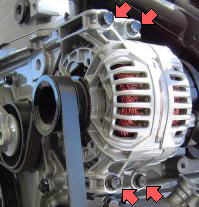
4. Unbolt and remove the alternator. Alternators usually have either two or four mounting bolts. On applications where the position of the
alternator can be adjusted to tighten the belt, two bolts are standard: a large pivot bolt (which usually has a hex nut on the inside end), and a
smaller adjustment bolt on the alternator support bracket. On applications where an automatic tensioner is used to maintain belt tension, the
alternator is usually rigidly mounted to the engine or front cover with four bolts.

5. Have your old alternator tested BEFORE you buy a replacement. Most auto parts stores have an alternator bench tester, and will test
your old alternator for free. Testing is a good idea to confirm the fact that the old unit has failed and needs to be replaced. Many alternators
that are assumed to be "bad" actually test "good" which means your charging problem is not the alternator but something else (a wiring problem, loose, damaged or
corroded wiring connectors, a faulty external voltage regulator or PCM). See the related article on Alternator Diagnostics.
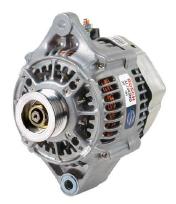
6. Buy a new or remanufactured replacement alternator for your vehicle (or get a good used unit that has been tested). Make sure it is the
correct unit for your vehicle application,. Many alternators look the same but have different power ratings and wiring connections.

7. Make sure the replacement alternator has the same pulley as your old unit. On many newer vehicles, special one-way overide pulleys or decoupler pulleys are used to
reduce noise and vibration. Cheaper replacement alternators may have only a standard pulley. It will work, but there may be noticeable change in
engine noise and vibration.
If the replacement alternator does not come with a pulley already installed on it, you will have to swap the pulley from your old alternator
to the replacement unit. This may require a puller tool to remove the old pulley from the alternator shaft. Applying heat with a propane torch to
the pulley hub may help loosen it for easier removal.
8. Mount the new alternator on the engine. Install all of the mounting bolts, but don't fully tighten the bolts if the alternator must
be rotated to tighten a V-belt or a serpentine belt that does not use an automatic tensioner.
9. Reconnect the wiring to the back of the alternator. Again, this may be easier before you mount the alternator on the engine if access
to the back of the alternator is limited. Just make sure all of the wires are routed correctly, and that all of the connections are clean and tight.
A poor contact here may prevent the alternator from working properly.

10. Reinstall the belt. Slip the belt over the pulleys, make sure it is aligned and routed correctly, then tighten the belt if no automatic
adjuster is used. This is done by carefully prying outward on the alternator housing until the belt is tight, then tightening the pivot and adjustment bolts.
You may need a helper for this step and three hands are better than two.
On applications that have an automatic belt tensioner, you have to rotate the tensioner inward and hold it so the serpentine belt can be slipped over the last pulley (which ever
pulley happens to be the easiest to get at for the final step).
Finish the job by reconnecting the battery, starting the engine and checking charging output with a voltmeter. You should see 13.5 to 14.5 volts if
the alternator and charging system are working correctly.

Warning: Never disconnect a battery cable while the engine is running to "test" the alternator. Doing so can cause high voltage spikes that can damage the alternator as well as other electronics.
Use a battery charger to recharge the battery. If your battery has run down, recharge it with a portable battery recharger BEFORE you start your vehicle. This will reduce the initial load on your new alternator and the risk of overheating it.
Test the battery to make sure it is still good. The condition of the battery should always be tested if it fails to hold a charge or a charging problem is suspected. The problem may be an old battery that needs to be replaced, not a bad alternator.
Install a new serpentine belt or V-belt. If your old belt has more than 60,000 miles on it, it may be worn and should be replaced to reduce the risk of slippage. Replace any belt that is cracked, damaged or contaminated with oil or grease.
Check the automatic belt tensioner. If the automatic belt tensioner is rusted, weak or stuck, it won't maintain the proper tension on the serpentine belt, allowing it to slip.
 Related Articles:
  Click Here to go to AA1Car Automotive Technical Articles