 More Air Conditioning Articles:

If you drive an older vehicle (pre-1994), the air conditioning system contains R-12 refrigerant (Freon). As long as the A/C system has no leaks and it cooling normally, there is no need to convert from R-12 to the new "ozone safe" R-134a refrigerant. But if your A/C system has lost it's charge because of a leak, collision damage, or the need to open it to replace a compressor, hose or other component, you may have to convert from R-12 to R-134a when you recharge the system
Why? Because R-12 is no longer produced in the U.S. Supplies of recycled R-12 still exist, and some R-12 is still brought in from offshore suppliers. But it is hard to find and expensive. That's why many people simply recharge their older R-12 air conditioning system with R-134a after repairs have been made.
Does it make economic sense to retrofit an older vehicle to R-134a if the A/C system has lost its refrigerant charge or needs major repairs? The older a vehicle gets, the more it depreciates. By the time it is 15 or more years old, it may only be worth a few hundred dollars. Many owners will not put any more money into an older vehicle unless the repairs are absolutely necessary to keep it running. Even then, it may be less expensive to get rid of the vehicle or to junk it than to fix it up. Even so, A/C is something that's hard to do without especially during hot weather. Hot summer temperatures and high humidity can make driving in city traffic unbearable.
A professional retrofit by a repair shop can cost hundreds of dollars, depending on what they do. But on many older vehicles, you can save money and do the job yourself - if you have some know-how and the right equipment.
There is NO reason to retrofit a vehicle to R-134a as long as the R-12 system is cooling properly and contains a normal charge of refrigerant. A/C systems designed to use R-12 will cool best when charged with R-12 refrigerant. Even if the system leaks, repairing the leaks and recharging it with R-12 is usually the best repair alternative. Converting to R-134a typically reduces cooling performance somewhat, and may require some additional modifications depending on the vehicle model year.
Where retrofit makes the most economic sense is when an A/C system requires major repairs such as a new compressor, condenser or evaporator.
The average repair bill to retrofit when other A/C repairs are needed, according to the Mobile Air Conditioning Society (MACS), is about $100 over and above any other repairs that may be needed (such as replacing the compressor, condenser or evaporator, etc.). The cost to retrofit usually does not add that much to the total repair bill because converting 1990s vintage vehicles to R-134a in most cases is fairly easy and does not require many (if any) changes. If the vehicle has barrier style hoses and the compressor and seals are compatible with R-134a, the only thing that has to be changed is the compressor lubricant.
A retrofit can be done one of two ways. The first is to follow the vehicle manufacturer recommended retrofit procedure. This generally involves removing all the old mineral oil from the system, replacing the accumulator or receiver/dryer with one that contains X-7 desiccant, replacing O-rings (if required), installing or replacing a high pressure cutout switch (which many shops seem to forget), changing the orifice tube or expansion valve (if required), then adding the specified PAG oil and recharging the system with R-134a. On some applications, installing a more efficient condenser may be recommended for improved cooling performance. After the modifications are made, the system is recharged to about 85 to 90% of its original capacity with R-134a.
Federal law also requires the permanent installation of R-134a fittings on the high and low service ports to reduce the chance of refrigerant cross-contamination the next time the vehicle is serviced. Labels must also be installed to identify the system has been converted to R-134a.
When the automotive industry made the shift to R-134a back in 1995-1995, they all published Technical Service Bulletins that covered retrofit procedures for their various makes and models. It takes some searching, but these detailed bulletins are still available on the various OEM Technical Service websites, most of which charge a fee to access.
Click Here for an example of Toyota's TSB that covers R-12 to R-134a retrofits on their vehicles.
You can also find OEM Retrofit bulletins on aftermarket service information websites such as AlldataDIY.com and Mitchell1DIY.com. These sites also charge a small subscription fee.
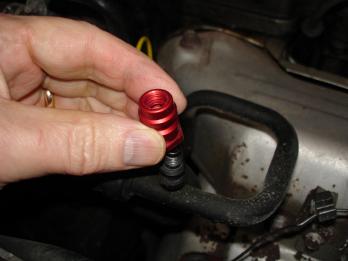
The other approach to retrofit is the "quick and cheap" one. On many 1989 through 1993 vintage vehicles, R-12 A/C systems can be converted by simply recovering any refrigerant that is still in the system, adding POE oil (which is compatible with both types of refrigerant), and recharging to 85 to 90% capacity with R-134a.
A simple retrofit may therefore cost no more than a few cans of refrigerant and some compressor oil -- provided there's nothing else wrong with the A/C system. But simple low cost retrofits may not give the best cooling performance, and may not even be possible on some vehicles. Any compressor that has Viton seals is not a candidate for retrofit. This includes original equipment compressors such as Tecumseh HR980, some Keihin compressors and some Panasonic rotary valve style compressors on older Japanese cars. On these, the compressor must be replaced.
Compressor durability can be a concern on some older applications. Because R-134a raises compressor discharge pressures and increases the compressors work load, some lightweight compressors may not be rugged enough to tolerate R-134a over the long haul. This applies to the Harrison DA6 and Ford FX-15 compressors. The Harrison DA6 can be replaced with a HD-6, HR-6 or HR-6HE compressor. The Ford FX-15 compressor can be replaced with a FS-10 compressor.
Regardless of which retrofit method is used, cooling performance will vary depending on the design of the system. As a rule, expect anywhere from a 3% to 15% decrease in cooling performance when an R-12 system is converted to R-134a. Systems with relatively large or efficient condensers will experience less of a drop in cooling performance with R-134a than those with smaller or less efficient condensers.
One way to improve cooling performance when retrofitting an older R-12 system to R-134a is to install a "variable valve" orifice tube in place of the standard fixed orifice tube. These aftermarket variable orifice tubes allow the flow rate through the valve to change for better cooling at idle and low speeds. Such a valve can lower the A/C outlet air temperature by as much as 5 to 8 degrees, which can make quite a difference if the vehicle is crawling along in stop-and-go city traffic.
Adding an extra cooling fan can help boost cooling performance, especially at idle and low speeds. Many older rear-wheel drive cars and trucks do not have a separate electric fan for the A/C condenser. They rely solely on the belt-driven fan for cooling, which may not be adequate in extremely hot weather with R-134a. Installing an auxiliary fan that comes on when the A/C is turned on give provide the extra airflow needed to carry away the heat.
Installing a larger or more efficient condenser can also help compensate for losses in cooling efficiency with R-134a. If the original condenser or evaporator is being replaced because of a leak, damage or defect, make sure the replacement unit has the same or better BTU rating. Some aftermarket replacement condensers and evaporators may not deliver the same cooling performance, and create a problem you did not have before.
When a compressor fails, it can throw metallic debris into the system. Most of the junk ends up in the bottom of the condenser, but some of it can also be blown back into the suction hose. Flushing the condenser, hoses and evaporator with refrigerant or an approved solvent may remove most of the debris, but parallel flow condensers cannot be flushed effectively. Replacement is often recommended if debris is found in the system. Most experts also recommend installing an in-line filter (high side and/or low side) to protect the replacement compressor and orifice tube or expansion valve. There are also filter screens that can be installed in the suction line to prevent any debris from reentering the compressor, too.
The vehicle manufacturers do not approve of any alternative refrigerants other than R-134a for retrofit. However, there are a variety of alternative refrigerants that meet EPA SNAP (Significant New Alternatives Policy) rules for environmental acceptance. Most of these are blends that are formulated to replace R-12 in older vehicles.
WARNING! Some so-called drop-in replacement refrigerants for older R-12 systems contain flammable hydrocarbons (propane, butane, isobuane, etc.). Flammable refrigerants do not meet the EPA's criteria for environmental acceptability or safety. These products include OZ-12, HC-12a, R-176 and R-405a. flammable reffrigerants are illegal because the EPA says they pose a significant fire danger to a vehicle's occupants should a leak occur. The EPA says a spark from a cigarette or a switch could ignite leaking refrigerant causing an explosion and fire.
To be fair, the makers of HC-12a contend that the flammability danger is highly exaggerated and there is "no evidence" to support claims that a cigarette or spark could ignite their product. They also contend that the EPA's position on their product is unjustified, and that HC-12a has been successfully used in many vehicle A/C systems worldwide with no accidents or injuries due to ignition.
Even so, we do NOT endorse or recommend using flammable refrigerants.
For more information, see Flammable Refrigerants.
In spite of the ban on R12 in the U.S., it is still manufactured offshore in some countries. We have heard numerous reports of bootleg R-12 coming into the U.S. market from Mexico. Bootleg R-12 obviously eliminates the need to retrofit your A/C system if you can find it, but we would warn that the purity and quality of bootleg R-12 is questionaable. It often contains other refrigerants (R-22, R-134a), flammable hydrocarbons (propane, butane, etc.), moisture and air. Poor quality R-12 may not perform well n your A/C system, and it may even cause problems such as noisy operation, sludge contamination and compressor failure. We do NOT recommend bootleg R-12 for these reasons.
It is important to remember that R-134a or any other alternative refrigerant cannot be mixed with R-12 or used to top off an R-12 system. If an A/C system still contains any R-12 at all, it must be removed using approved recovery equipment (venting is not allowed) before a new refrigerant is added to the system. This is an absolute must to prevent cross-contamination of refrigerants and cooling performance problems.
Mixing different refrigerants can cause big problems. For one, it will increase the system operating pressure. This can result in a loss of cooling performance and may overtax the compressor to the point where it fails. R-134a and mineral oil will not mix. So if somebody recharges an R-12 system with R-134a and does not add a compatible lubricant, the compressor will soon fail.
MACs did a field survey of older vehicles with R-12 A/C systems a number of years ago, and here is what they found:
The same survey also revealed that only one out of 10 technicians in the U.S. knew about EPA SNAP rules, the Significant New Alternatives Policy regulations that prohibit refrigerant venting, require recovery and recycling, prohibit the intermixing of different refrigerants or the use of flammable refrigerants.
Two out of five technicians also did not know the service fittings on an A/C system MUST be changed if the system is converted from R-12 to R-134a or anything else. And three out of five technicians did not know mixing R-12 and R-134a could cause problems.
More Air Conditioning Articles: Click Here to See More Carley Automotive Technical Articles