
Home, Auto Repair Library, Auto Parts, Accessories, Tools, Manuals & Books, Car BLOG, Links, Index
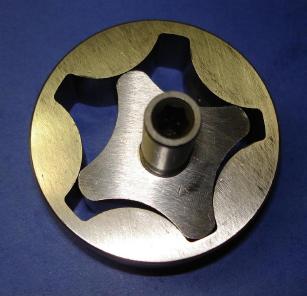
Every engine requires a certain amount of oil flow to keep the bearings, camshaft, valvetrain and other moving parts lubricated. This is provided by the oil pump. But the oil pump doesn't actually create oil pressure. All the pump does is displace oil and push it into the oil galleys so it can flow to the bearings and upper valvetrain. What actually creates the oil pressure is the resistance the oil encounters as it circulates through the engine.
How much pressure should a good oil pump produce? Most manufacturers recommend a minimum of 10 psi of oil pressure for every 1,000 RPM of engine speed. Using these numbers, most stock oil pumps make about 50 to 60 PSI of oil pressure.
There are three basic types of oil pumps:
Twin gear pumps (also called external pumps) are mounted inside the oil pan on the bottom of the engine and use a pair of intermeshing gears to pump oil. One gear is driven by a shaft and the second gear is driven by the first gear. The pump is usually driven by a shaft that connects to the crankshaft, camshaft or distributor shaft. Thus, the pump operates at half engine rpm. The pump gears turn in opposite directions. This traps oil between the gear teeth and carries it around the outside of each gear from the pickup tube inlet to the pump outlet. The tight clearances between the gears prevents the oil from flowing backwards to the inlet.

Rotor pumps (also called "gerotor" pumps) have an inner gear that turns inside an outer rotor. The inner gear has one less lobe than the outer rotor. The inner gear is also mounted slightly offcenter to the outer rotor which forces the outer rotor to spin at about 80% of the speed of the inner gear. This creates a bellows-like pumping action that pulls oil from the inlet port and pushes it towards the outlet port. Close tolerances are required for good pumping efficiency. This type of pump may also be located in the crankcase.
Front cover oil pumps (also called internal/external pumps) are usually located in the front engine cover. This is also a rotor style pump with an inner drive gear and outer rotor, but the inner gear is mounted directly on the crankshaft. The direct drive approach eliminates the need for a separate pump drive shaft. This type of pump turns at the same rpm as the engine, so it generates more pressure at idle than a camshaft or distributor driven pump (which only turns at half engine speed). This type of pump is used on many overhead cam engines, but also many late model pushrod engines such as Chevy LS engines and Ford modular V6 and V8 engines.
One of the drawbacks of front mounted oil pumps is that the oil has to travel a further distance from the oil pan to the pump. This can slow the flow of oil when the engine is cold and is first started. On many such applications, lower viscosity motor oil (such as 5W-20 or 5W-30) is recommended so oil will reach the pump more quickly during cold weather.
When this type of pump becomes worn, it is not always necessary to replace the entire front cover assembly, provided the pump housing inside the cover is not worn or damaged. A new drive gear can be mounted on the crankshaft and a new rotor installed in the cover to rejuvenate the pump.
Something else to be aware of with front mounted pumps is that the alignment of the pump rotor within the housing is critical. It must be exactly centered in the housing before the housing mounting bolts are tightened otherwise the pump can be damaged when the engine is first cranked and started. Shims or feeler gauges should be used to make sure the pump rotor is centered within its housing. If possible this should be done with the engine out of the vehicle and with the block sitting upright on end so the crankshaft is vertical rather than horizontal. This helps assure the crankshaft is centered within the main bores. If the block is in the vehicle or the block is mounted on an engine stand with the crankshaft in a horizontal position, the crank will be resting on the lower main bearings and will not be perfectly centered in the main bores. Only a couple thousandths of an inch off center can be enough to damage a front mounted oil pump.
With all three types of pumps, wear and damage are major concerns. Wear that increases internal clearances between the gears, rotor and housing will reduce the amount of oil the pump displaces and cause a drop in oil pressure and delivery volume. For this reason, high mileage oil pumps when you are rebuilding your engine or if your engine has a low oil pressure problem.
Low oil pressure indicates trouble and may be caused by a low oil level, worn main and rod bearings or a worn oil pump. Low oil pressure can lead to bearing seizure and engine failure, so it should not be ignored. Sometimes a bad oil pressure sending unit will give a false alarm. But if oil pressure is really low and the crankcase is full, the engine may need bearings and/or a new oil pump.
Replace the oil pump if it is worn and is not developing normal oil pressure. A new pump is recommended if you are rebuilding an engine or installing new crankshaft bearings.
Oil Pump Pickup Screen
The oil pump pickup tube and screen should also be replaced if you are replacing your oil pump. Oil screens are difficult to clean and can trap engine-damaging debris inside where you can't see it. If this debris loosens up and is sucked into the engine later, it could cause problems. The oil filter won't catch it because oil that enters the pump is unfiltered except for the inlet screen (which only stops big chunks of junk from being sucked into the pump from the bottom of the oil pan).
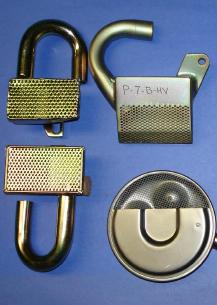
For most engines, a stock replacement oil pump should work fine. But for some high performance applications, you might want to consider a High Volume oil pump.
High volume pumps typically have longer gear sets to displace more oil. A high volume oil pump may flow 20 to 25 percent more oil than a stock pump to increase oil pressure at idle and to compensate for increased bearing clearances if you are building an engine with looser bearing clearances (say .002 or more). Most bearing manufacturers recommend around .0015 inches of clearance on the main and rod bearings for street engines, and .002 to .003 inches for drag engines.
A high pressure oil pump, by comparison, uses a stiffer relief valve that does not open until a higher pressure is reached (75 psi or higher). This type of pump can provide additional oil pressure at high RPM but will not have any effect on idle oil pressure when the pump is turning slowly. The question is, do you really need more pressure? Pressure increases parasitic drag created by the pump. That's why many NASCAR teams run with very low oil pressure (5 PSI for every 1000 RPM) but with tighter bearing clearances and low viscosity synthetic motor oils (such as 0W-20). Less horsepower turning the pump means more horsepower at the flywheel.

Never install a new oil pump without first adding oil to the pump housing. This is especially important with front mounted oil pumps that are driven off the crankshaft.
Crankcase mounted oil pumps that are located inside the oil pan on the bottom of the engine are submerged in oil and will self-prime very quickly when the engine is cranked. This is NOT the case with front-mounted oil pumps because they are mounted high and dry, and a long ways from the oil pan.
Front-mounted oil pumps should have oil added to the pump housing before the pump is bolted in place. The pump should then be prelubed by removing a nearby oil galley plug and pouring oil into the gallery through a hose and funnel so there will be some oil in the pump BEFORE the engine is cranked. Or,you can use a pressure oiler to prime the system at an oil gallery plug or the oil pressure sending unit fitting before the engine is cranked. Not priming the pump may result in a dry start and damage the pump and/or crankshaft bearings if the pump fails to develop any oil pressure.
 More Oil Pump and Lubrication Articles:
 Click Here to See More Carley Automotive Technical Articles