
Home,
Auto Repair Library, Auto Parts, Accessories, Tools, Manuals & Books, Car BLOG, Links, Index

How to Troubleshoot Exhaust Noise & Leaks
Copyright AA1Car
Exhaust noise always means trouble. But even if you can't hear anything, it may be leaking. Any time you are under your vehicle to change oil or do other repairs, you should take a few minutes to inspect the exhaust system.
Though most original equipment exhaust systems typically go about five to seven years before mufflers and pipes start to rot, some fail even sooner - especially if the vehicle has been exposed to a lot of winter salt or subjected to frequent short-trip stop-and-go driving.
Short trips, especially during cold weather, leave a lot of condensation in the exhaust system. The muffler and pipes never get hot enough to evaporate any collected water.
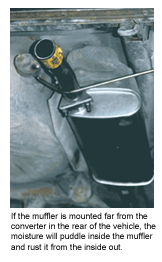
If the muffler is mounted far from the converter in the rear of the vehicle, the moisture will puddle inside the muffler and rust it from the inside out. Water combines with sulfur in the exhaust to form highly corrosive acids that eat away at the metal.
Mufflers and resonators mounted aft of the rear axle are especially vulnerable to this type of corrosion because they run much cooler than front-mounted mufflers. Thus they become a moisture trap - and often fail because of internal corrosion.
How To Inspect Your Exhaust System
Start your inspection at the engine and go all the way back to the tailpipe. One place where exhaust leaks often develop and go undetected is where the exhaust manifold mates to the cylinder head. The thermal expansion and contraction that occurs every time an engine is started, driven and shut off creates a lot of shear stress on the exhaust manifold gasket. After several years, it's not unusual for small leaks to develop. And over time, the small leaks usually get bigger.
On some late-model engines, exhaust manifold cracking has also been a problem because thinner castings are used to reduce weight. Some replacement manifolds have thicker castings to improve strength and resist cracking.
An exhaust manifold leak can be especially dangerous because it provides a direct path for carbon monoxide to enter the passenger compartment through the cowl vent at the base of the windshield, or past hose and wire grommets in the firewall. The escape of hot gases can also burn nearby spark plug wires and plug boots.
Clues to look for include an intermittent hiss or popping noise when the engine is running, discolored or burned paint next to the exhaust ports on the cylinder head, or burned spark plug wires or boots.
Another point where exhaust gases tend to leak is the mating point between the exhaust manifold and head pipe - especially in front-wheel drive cars with transverse mounted engines. The back-and-forth motion of the engine caused by the application of drive torque produces a lot of movement at the point where the head pipe mates with the exhaust manifold. On some front-wheel drive cars, the head pipe has a flexible section to handle the motion. On others, the flange that holds the head pipe to the manifold is spring loaded.
A graphite donut gasket and/or a "ball and socket" head pipe flange may also be used to allow some flexibility in the joint. But over time, any of these systems can fail. And when they do fail, they pose the same risks as a manifold leak. Clues to look for include noise and hot gases escaping from the joint, and discoloration around the joint.
A visual inspection of the rest of the exhaust system will usually reveal any obvious problems like holes in the muffler, cracked or damaged pipes, broken or missing hangars, etc. The most common leak points are where the exhaust pipes mate with the muffler, resonator and converter, the seams in the shells of the muffler, resonator and converter, and where pipes joint together. The hump in the exhaust pipe where it goes over the rear axle is another point where cracks or damage may be found.
Exhaust Leak Dangers
Exhaust leaks should never be ignored because they can have serious consequences any time of year. Because it is colorless and odorless, carbon monoxide gas can be lethal, especially if the windows are rolled up and the deadly gas finds its way inside the passenger compartment.
According to a research report published several years ago by the EPA, as many as one out of every five cars involved in accidents may have elevated levels of carbon monoxide inside the passenger compartment.
WARNING: Even a small exhaust leak that causes exhaust gases to get inside the vehicle can affect a driver's judgment and perception. As little as 0.08 percent carbon monoxide (that's only 800 parts per million) can cause dizziness, headaches, nausea, and bring on stupor in two hours. A one percent concentration level of carbon monoxide can kill a person in less than three minutes!
If you hear any exhaust noise, the muffler or pipes are probably leaking and repairs are needed. Don't put off any repairs that might be needed because delays can be deadly!
Test The Exhaust Pipes
Use a large pair of expandable pliers to test suspicious pipes. The pliers will tell you if the pipes are rotten or solid. If the pipe gives when pressure is applied, it needs to be replaced. Poking at rusted areas on the muffler, resonator or converter shell will also tell you if the corrosion is on the surface or goes all the way through the metal.
You should also check the system while the engine is running. A live test is always better because any exhaust leaks are usually obvious.
Something else you are more likely to detect with the engine running is any buzzing or rattling that may be present. This type of sound can be caused by loose heat shields around the catalytic converter or exhaust pipes.
Rust often weakens the spot welds that hold the heat shields to the exhaust system. When the weld fails, the shield comes loose just enough to vibrate and produce a rattle or buzz that reverberates throughout the entire vehicle. The noise may only be heard at certain engine rpms or when decelerating when harmonic vibrations shake the exhaust system at a resonant frequency.
Loose heat shields may not be obvious with a simple visual inspection, so use a medium-sized screwdriver to check the shields for looseness. Gently pry between the shield and converter or pipe to see if any of the spot welds or mounting flanges have failed. Loose heat shields can be secured by rewelding, or by installing clamps. If a shield is damaged or badly rusted, replacement is recommended.
Do not remove loose heat shields! The vehicle manufacturer installs them for a purpose. Heat shields are needed to keep heat away from the floor pan of the vehicle, as well as other components like brake lines and fuel lines that may be nearby.
All too often, the original heat shields are left off when replacing exhaust components because somebody doesn't want to take the time to install them - or because the original shields are too badly rusted to be reused.
Exhaust Noise
Another source of buzzing noises in the exhaust, especially on high revving four-cylinder engines, is harmonic resonance. This is typically loudest at certain engine rpms and/or when accelerating hard under load. Original equipment exhaust systems are typically tuned to dampen the more annoying high pitched tones, which is why many OE exhaust systems have a second muffler or resonator. The length, shape and chamber design of the resonator is designed to silence certain sound frequencies in the exhaust.
If the OE muffler has been replaced with a straight pipe or a poorly designed replacement resonator or muffler, the exhaust system may not do a very good job of quieting the more annoying sound frequencies. The cure here would be to replace any missing components in the system (typically the resonator), and/or to install a better quality replacement muffler.
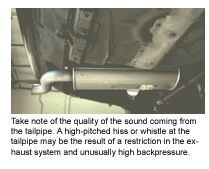
You should also note the quality of the sound coming from the tailpipe. A high-pitched hiss or whistle at the tailpipe may be the result of a restriction in the exhaust system and unusually high backpressure. If the engine lacks high-speed power and is getting poor fuel mileage, it is a pretty good clue that the engine is having trouble exhaling.
Exhaust Restriction
If a vehicle has been getting poor fuel economy or has a loss of power, the exhaust system might have an internal restriction or blockage. Exhaust system restrictions can be caused by damaged or crushed pipes, or collapsed baffles inside a muffler or resonator. But the most common cause these days often turns out to be a plugged catalytic converter.
A quick way to check for a suspected exhaust restriction is to read the engine's intake manifold vacuum at idle. Most engines should have about 18 or more inches of vacuum at idle. A lower-than-normal reading is a classic symptom of excessive backpressure in the exhaust.
Exhaust Backpressure
Backpressure can be measured directly several ways. One is to measure it at the air pump check valve. Remove the check valve and install a pressure gauge. However, the check valve must connect to the exhaust system ahead of the converter. (Note: if the plumbing hooks up at the converter, this technique won't give you reliable results.)
Backpressure readings should generally be less than 1.5 psi (though some do allow as much as 2.75 lbs. at idle). Rev the engine to 2,000 rpm and note how much the reading increases. If it's higher than 3 psi - or keeps climbing - you've identified a restriction problem.
Backpressure can also be measured by removing the oxygen sensor from the exhaust manifold and installing an 18mm adapter to hook up a pressure gauge. But all this will tell you is whether or not there's too much backpressure in the exhaust. It won't tell you where.
If you see no obvious damage to the exhaust system, such as a crushed pipe, disconnect the exhaust pipe aft of the converter and check intake vacuum or backpressure again. A return to normal readings would tell you the problem is in the muffler, while no change in readings would tell you the problem is in the converter.
Plugged Catalytic Converter
You can also check for a plugged converter by removing it, holding a shop light at one end and peering in the other end. With honeycomb-style converters, you should be able to see the light. No light means a plugged converter.
Converter failures of this type usually occur because of ignition misfire or a leaky exhaust valve that has been allowing unburned fuel to enter the exhaust system.
When that unburned fuel hits the converter, it ignites, sending the converter's operating temperature soaring. This breaks down and melts the honeycomb substrate that supports the catalyst, creating a partial or complete blockage.
Replacing a plugged converter will temporarily restore free breathing, but unless the cause of the converter failure is also diagnosed and corrected, chances are the replacement converter will suffer the same fate.
As for checking converter performance, there's probably no need unless the vehicle has failed an emissions test. On 1996 and newer vehicles with OBDII, a downstream oxygen sensor monitors the efficiency of the converter and triggers the Check Engine light if the converter is not doing its job.
But on older vehicles, there are no self-diagnostics for detecting a tired or contaminated converter. An exhaust analyzer is needed to check the converter. Another method is to check the converter inlet and outlet temperatures with an infrared thermometer. The outlet should be 50 or more degrees F. hotter than the inlet if the converter is working.
Exhaust Pipe and Muffler Replacement Tips
If a muffler or resonator has failed, don't replace it without checking the integrity of the pipes on both sides.
Pipes that often appear to be OK on the outside may, in fact, be seriously weakened on the inside as a result of internal corrosion.
For a whisper-quiet exhaust, install a quality replacement muffler. Direct fit are easier to install than universal-style mufflers and maintain the OE appearance of the exhaust system.
Even so, you might upgrade to an aftermarket performance muffler or a free-flowing exhaust system if more power and/or a more powerful sound is desired.
 More Exhaust System Articles:
How to Replace a Muffler
Catalytic Converters
Catalytic Converter Thefts at All-Time High
Performance Mufflers
 Click Here to See More Carley Automotive Technical Articles
Be sure to visit our other websites:

OBD2HELP
Random-Misfire
ScanToolHelp
TROUBLE-CODES